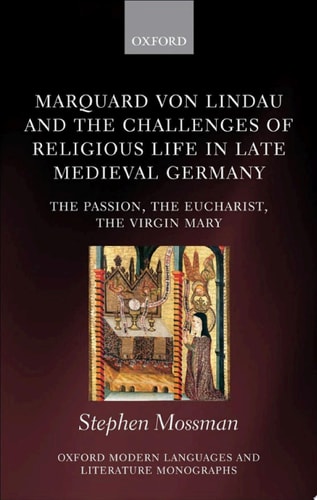
Marquard von Lindau and the Challenges of Religious Life in Late Medieval Germany: The Passion, the Eucharist, the Virgin Mary
0
0
As an Amazon Associate and affiliate partner, Menrva Books earns from qualifying purchases. Learn more
Author Description
This is a study of the intellectual history and religious culture of German-speaking Europe in the late Middle Ages. Its focus is the bilingual oeuvre of the Franciscan friar Marquard von Lindau (d. 1392), arguably the most widely-read author in the German language before the Reformation. His most successful works were those in which he considered pragmatic issues of Christian life, aimed at a broad reading public that stretched from monks and nuns living the contemplative life in enclosed convents; to his confreres, novices and students in the mendicant orders; and the literate citizens of the burgeoning mercantile centres. It is three of these pragmatic issues, central to late medieval religious life, around which this book is structured: the Passion of Christ, the sacrament of the Eucharist, and the devotion to the Virgin Mary. The dominant approaches taken towards each of these in the fourteenth-century church represented problematic challenges to Marquard; challenges which he met in a distinctive and influential manner, by no means in accordance with the affectively-charged devotional practices encouraged by many within and without his order, and so often considered normative for late medieval religious culture. The original voice with which Marquard spoke is made clear through the location of his oeuvre within the pan-European context of the debates in which his works participate. The ethos his works projected redetermined the trajectory of intellectual life in Germany into the fifteenth century and beyond.
Menrva's Summary
THE THESIS
This study investigates how the Franciscan friar Marquard von Lindau navigated the complex theological and devotional challenges of late fourteenth-century Germany through his influential bilingual writings. Stephen Mossman, a scholar of medieval German literature and history, utilizes an extensive analysis of Lindau's surviving manuscripts to argue that the friar offered a distinct, pragmatic alternative to the dominant affectively-charged devotional practices of his time. By situating Lindau's work within the broader European intellectual context, the book demonstrates how his specific approach to the Passion, the Eucharist, and the Virgin Mary shaped the trajectory of German religious culture leading into the fifteenth century.
THE SCOPE MAP
What You Will Find
- Analysis of the bilingual oeuvre of Marquard von Lindau.
- Examination of late medieval debates regarding the Passion of Christ, the Eucharist, and Marian devotion.
- Contextualization of Lindau's work within the mendicant order and the broader mercantile society of the era.
- Exploration of the transition from contemplative monastic life to the religious needs of the literate urban laity.
Scope Limits
- The study focuses primarily on the three specific theological pillars mentioned rather than a comprehensive biography of the author.
- The analysis is restricted to the intellectual and religious climate of German-speaking Europe in the fourteenth century.
THE AUTHORITY PERSPECTIVE
Scholars recognize this work as a significant contribution to the study of pre-Reformation German intellectual history and the dissemination of religious texts. Experts frequently highlight the book's success in challenging the assumption that affective piety was the sole normative mode of religious expression in the late Middle Ages.
Page Count:
390
Publication Date:
2010-01-01
Publisher:
OUP Oxford
ISBN-10:
0191610321
ISBN-13:
9780191610325
History
Lords supper
Bible
Intellectual History
Theology
Religious History
English & College Success
German
English
Community Tags
Similar Books