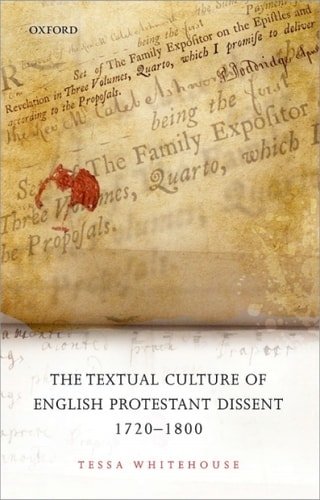
The Textual Culture of English Protestant Dissent: 1720-1800
0
0
As an Amazon Associate and affiliate partner, Menrva Books earns from qualifying purchases. Learn more
Author Description
Religious dissenters and their literary and social heritage are the principal subjects of this book. At its heart is a group of English men whose activities were local, transcontinental and circum-Atlantic. Drawing on letters, lecture notes, manuscript accounts of academies, and a range of printed texts and paratexts The Textual Culture of English Protestant Dissent 1720-1800 explores the connections between dissent, education, and publishing in the eighteenth century. By considering Isaac Watts and Philip Doddridge in relation to their mentors, students, friends, and readers it emphasizes the importance they and their associates attached to personal relationships in their private interactions and in print. It argues that this contributed to a distinctive literary style as well as particular modes of textual production for moderate, orthodox dissenters which reached beyond their own community to address and influence global discourses about education, enlightenment, and history. The book's focus on 'textual culture' foregrounds relationships between forms as well as considering texts as they existed in one form or another. In examining textual culture, this book emphasises adaptation, transformation, fluidity and communality: it approaches the human relationships that make texts (including friendships, reading communities, intellectual exchange and business arrangements) with as much care as the content of the texts themselves. The book demonstrates that models of family and social authorship among Romantic-era dissenters advanced by Michelle Levy, Daniel White and Felicity James were rooted in the domestic culture at earlier academies and in the example of members of the Watts-Doddridge circle.
Menrva's Summary
THE THESIS
This book investigates how the textual practices and social networks of eighteenth-century English Protestant dissenters shaped their literary output and broader intellectual influence. Tessa Whitehouse, a scholar specializing in eighteenth-century literature and religious history, utilizes a diverse range of archival materials to argue that the collaborative, domestic, and educational environments of dissenters like Isaac Watts and Philip Doddridge fostered a unique mode of authorship. By analyzing the intersection of personal relationships and print culture, the author demonstrates how these moderate, orthodox figures contributed to global discourses on education and enlightenment.
THE SCOPE MAP
What You Will Find
- Analysis of letters, lecture notes, and manuscript accounts from eighteenth-century dissenting academies.
- Examination of the Watts-Doddridge circle and their influence on later Romantic-era literary models.
- Exploration of the relationship between private social interaction and public textual production.
Scope Limits
- The study focuses primarily on moderate, orthodox dissenters rather than radical or heterodox groups.
- The research is bounded by the years 1720 to 1800, excluding earlier or later developments in dissenting culture.
THE AUTHORITY PERSPECTIVE
Scholars in the field of eighteenth-century studies recognize this work as a significant contribution to the understanding of non-conformist intellectual history. Readers frequently note the academic density of the prose and the author's meticulous use of primary source materials to reconstruct the social dynamics of dissenting communities.
Page Count:
272
Publication Date:
2015-01-01
Publisher:
OUP Oxford
ISBN-10:
0191027677
ISBN-13:
9780191027673
History
Cultural History
Religion and literature
Protestantism
Literary Criticism
English
English & College Success
Eighteenth Century
Religious History
Community Tags
Similar Books