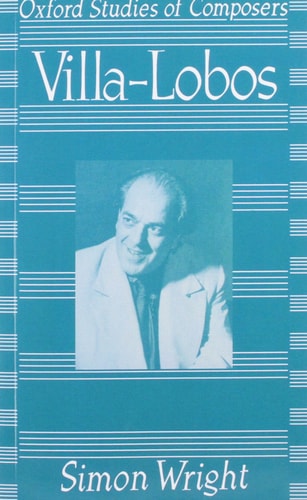
Villa-Lobos
0
0
As an Amazon Associate and affiliate partner, Menrva Books earns from qualifying purchases. Learn more
Author Description
The music of the prolific Heitor Villa-Lobos (1887-1959) typifies Brazil, in its diversity, spirit of racial amalgam, and awesome beauty. Through the sheer quantity of his output, his original use of folkloric material, and the striking accessibility of his scores, Villa-Lobos has become the best-known and most significant Latin American composer of all time. This book provides an introduction to his music, and by focusing attention on important or unusual works from his large oeuvre, charts Villa-Lobos's own often anguished musical journey through the Brazilian landscape. Jungle, grasslands, river, city, and ocean all find a legitimate place in his aural mosaic of Brazil, but as he approached death his music assumed a deep spiritual quality of peace and resignation. His personal journey of discovery and fulfillment is clearly explained, set against the pervasive backdrop of social and political upheaval which characterized Brazil during Villa-Lobos's lifetime.
Menrva's Summary
THE THESIS
This book investigates the musical development and cultural significance of Heitor Villa-Lobos within the context of 20th-century Brazilian history. Simon Wright, a specialist in Latin American music, utilizes a biographical and musicological framework to examine how Villa-Lobos integrated indigenous folkloric elements into Western classical structures. The text argues that the composer's output serves as a sonic representation of Brazil's diverse geography and social evolution.
THE SCOPE MAP
What You Will Find
- Analysis of key compositions from Villa-Lobos's extensive catalog
- Historical context regarding the political and social climate of Brazil (1887-1959)
- Examination of the composer's transition from folkloric experimentation to late-career spiritual introspection
Scope Limits
- The text does not provide a complete, exhaustive catalog of every minor work composed by Villa-Lobos
- It does not focus on technical music theory or complex harmonic analysis for professional musicologists
THE AUTHORITY PERSPECTIVE
Experts frequently cite this work as a foundational introduction for those seeking to understand the intersection of Brazilian identity and classical composition. Readers often note that the prose remains accessible while providing sufficient academic rigor for students of music history.
Page Count:
146
Publication Date:
1992-04-16
Publisher:
Oxford University Press
ISBN-10:
0193154757
ISBN-13:
9780193154759
Music
Biography
American Studies
Music History
Community Tags
Similar Books