Monotheism in Islam and Other Religions: An Analytical Study in the Writings of Abu Al-Kalām Azād
0
0
As an Amazon Associate and affiliate partner, Menrva Books earns from qualifying purchases. Learn more
Author Description
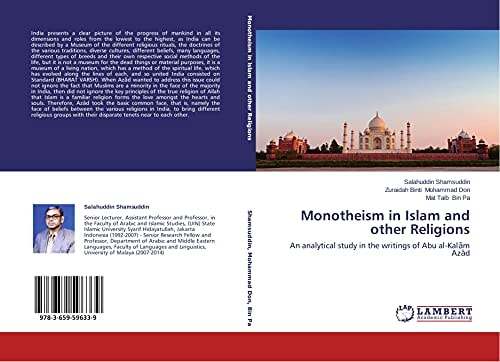
India presents a clear picture of the progress of mankind in all its dimensions and roles from the lowest to the highest, as India can be described by a Museum of the different religious rituals, the doctrines of the various traditions, diverse cultures, different beliefs, many languages, different types of breeds and their own respective social methods of the life, but it is not a museum for the dead things or material purposes, it is a museum of a living nation, which has a method of the spiritual life, which has evolved along the lines of each, and so united India consisted on Standard (BHARAT VARSH). When Azād wanted to address this issue could not ignore the fact that Muslims are a minority in the face of the majority in India, then did not ignore the key principles of the true religion of Allah that Islam is a familiar religion forms the love amongst the hearts and souls. Therefore, Azād took the basic common face, that is, namely the face of beliefs between the various religions in India, to bring different religious groups with their disparate tenets near to each other.
Menrva's Summary
THE THESIS
This book analyzes the concept of monotheism as presented in Islam and its parallels with other religious traditions, drawing specifically from the writings of Abu Al-Kalām Azād. The work explores India's rich religious landscape as a backdrop for understanding Azād's approach to interfaith dialogue. It details how Azād, recognizing the minority status of Muslims in India, sought common ground in shared beliefs to foster unity among diverse religious groups, emphasizing Islam's core tenets of love and spiritual life.
THE SCOPE MAP
- Analysis of monotheism in Islam.
- Comparative study of monotheistic beliefs across various Indian religions.
- Examination of Abu Al-Kalām Azād's writings and theological perspectives.
- Exploration of India as a diverse religious and cultural milieu.
- Discussion of Azād's strategy for interfaith harmony.
- Focus on shared beliefs as a foundation for religious understanding.
THE AUTHORITY PERSPECTIVE
The book offers a scholarly examination of monotheism, particularly through the lens of Abu Al-Kalām Azād's work within the Indian religious context. It highlights Azād's efforts to find commonalities between Islam and other faiths to promote understanding and unity. The analysis delves into the complexities of religious diversity in India and Azād's approach to navigating these differences. The work is positioned as a study of theological and historical significance.
Page Count:
124
Publication Date:
2014-01-01
Publisher:
Lap Lambert Academic Publishing GmbH KG
ISBN-10:
3659596337
ISBN-13:
9783659596339
Non-Fiction
Religion
History of religion
Theology
Community Tags
Similar Books