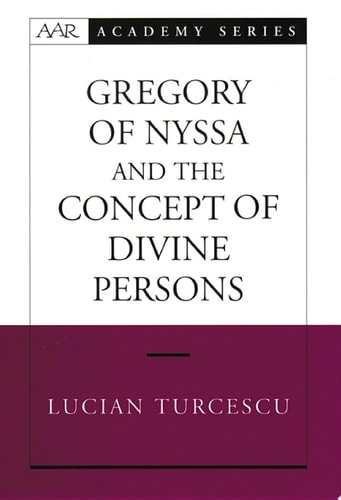
Gregory of Nyssa and the Concept of Divine Persons
0
0
As an Amazon Associate and affiliate partner, Menrva Books earns from qualifying purchases. Learn more
Author Description
The concept of personhood is central to a wide range of contemporary issues, ranging from reproductive rights to the death penalty and euthanasia. We may think that the concept of person is a modern development. In fact, however, this idea does not originate with our discovery of human rights, consciousness, and individuality. In this study Lucian Turcescu shows that the fourth-century theologian Gregory of Nyssa developed a very sophisticated concept of the person in the context of his attempts to clarify the paradox of the Trinity-a single God comprising three distinct persons. Turcescu offers the first in-depth analysis of Gregory's writings about the divine persons. He shows that Gregory understood personhood as characterized by uniqueness, relationality, and freedom. He reasoned that the three persons of the Trinity have distinctive properties that make them individuals, that is, capable of being enumerated and circumscribed. But this idea of individuation, inherited from the neo-Platonists, falls short of expressing a clear notion of personal uniqueness. By itself it would suggest that a person is merely a collection of properties. Gregory's great contribution was to perceive the importance of relationality to personhood. The three divine persons know and love each other, are in communion with each other, and freely act together in their common will. This understanding, argues Turcescu, adds up to a concept of personal uniqueness much like our modern one. Turcescu's work not only contributes to our knowledge of the history of Trinitarian theology but can be helpful to theologians who are dealing with issues in contemporary ethics.
Menrva's Summary
THE THESIS
This study investigates how the fourth-century theologian Gregory of Nyssa formulated a sophisticated concept of personhood while attempting to resolve the Trinitarian paradox. Lucian Turcescu, a scholar of patristic theology, examines Gregory's writings to demonstrate that the modern understanding of the person—defined by uniqueness, relationality, and freedom—has deep roots in ancient theological discourse. By analyzing Gregory's synthesis of neo-Platonic individuation and Christian communion, Turcescu argues that these historical insights remain relevant for contemporary ethical debates regarding human rights and individuality.
THE SCOPE MAP
What You Will Find
- An analysis of Gregory of Nyssa's Trinitarian theology.
- A breakdown of the concepts of uniqueness, relationality, and freedom in patristic thought.
- A historical critique of neo-Platonic influences on early Christian definitions of the individual.
Scope Limits
- The text does not provide a comprehensive history of all Trinitarian debates in the fourth century.
- The book does not offer a direct application to modern legal or political policy, focusing instead on the theological foundation of personhood.
THE AUTHORITY PERSPECTIVE
Scholars and theologians frequently cite this work as a foundational text for understanding the development of the concept of the person in early Christian thought. Readers often note the academic density of the prose, which requires a background in historical theology to fully grasp the nuances of the argument.
Page Count:
186
Publication Date:
2005-01-01
Publisher:
Oxford University Press
ISBN-10:
0190291729
ISBN-13:
9780190291723
Philosophy
Religion
Patristics
Christian Doctrine
Ethics
Theology
History of religion
Trinity
Community Tags
Other Editions(4)


Similar Books
Reader Comments
Share Your Thoughts
No comments yet. Be the first to share your thoughts!