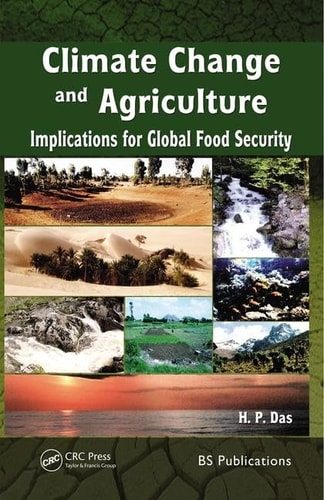
Climate Change and Agriculture: Implications for Global Food Security
0
0
As an Amazon Associate and affiliate partner, Menrva Books earns from qualifying purchases. Learn more
Author Description
One of the greatest challenges facing humankind is to minimize the impact of human-induced climate change on the agricultural production and also on the production from livestock, forestry and fisheries sectors. Ever-expanding global population and increased income is likely to generate an increase in demand for food and fibre by the middle of this century. At the same time the lands and fresh water resources available for expansion of agriculture may be of lower quality than those currently in use. In order to minimize possible adverse consequences including production losses, food price increases, and food insecurity, there needs to be greater intensive agriculture. This can be achieved by adoption of efficient adaptation techniques in combination with measures taken to preserve the environment and to use resources more efficiently. The range of adaptation options for agriculture, forestry, and fisheries is generally increasing because of technological advances, thus reducing the vulnerability of these systems to climate change. However, in many developing countries technology generation, innovation, and adoption are too slow to sufficiently counteract the increasingly negative effects of climate change. This book represents a major step in understanding the science of various aspects of climate change with likely impacts on agriculture, livestock, forestry, and fisheries with clear adaptation strategies required to reduce their vulnerability.
Menrva's Summary
THE THESIS
This book investigates the complex interplay between climate change and global agriculture, examining its profound implications for food security. The text addresses the dual challenge of an ever-expanding global population demanding more food and fiber, while facing diminishing arable land and freshwater resources. It posits that intensive agriculture, achieved through efficient adaptation techniques, environmental preservation, and resource efficiency, is crucial to mitigate adverse consequences such as production losses and price increases. While technological advances offer increasing adaptation options, the book highlights the slow pace of technology adoption in developing nations as a significant barrier to counteracting climate change's negative effects.
THE SCOPE MAP
- Analysis of climate change impacts on agricultural production, livestock, forestry, and fisheries.
- Examination of the growing global demand for food and fiber due to population growth and increased income.
- Assessment of the limitations imposed by declining quality and availability of land and freshwater resources for agriculture.
- Discussion of intensive agriculture as a strategy to minimize adverse consequences like production losses and food insecurity.
- Exploration of adaptation techniques and measures for environmental preservation and efficient resource utilization.
- Review of technological advancements in adaptation options for agriculture, forestry, and fisheries.
- Identification of barriers to technology generation, innovation, and adoption in developing countries.
- Presentation of clear adaptation strategies to reduce the vulnerability of these sectors to climate change.
THE AUTHORITY PERSPECTIVE
The book addresses a critical global challenge, synthesizing scientific understanding of climate change's effects on vital sectors like agriculture, livestock, forestry, and fisheries. It emphasizes the need for adaptive strategies to ensure food security amidst growing demand and environmental constraints. The text likely appeals to researchers, policymakers, and professionals in agriculture and environmental science seeking to understand and address these complex issues. The focus on adaptation strategies suggests a practical orientation, aiming to inform solutions for a more resilient food system.
Page Count:
612
Publication Date:
2016-01-01
Publisher:
BS Publications for CRC Press, Taylor & Francis Group
ISBN-10:
1498769764
ISBN-13:
9781498769761
Science
Non-Fiction
Food security
Global Issues
Agriculture
Climate Change
Community Tags
Similar Books