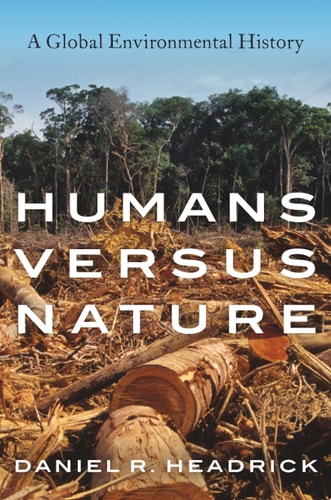
Humans versus Nature: A Global Environmental History
0
0
As an Amazon Associate and affiliate partner, Menrva Books earns from qualifying purchases. Learn more
Author Description
Since the appearance of Homo sapiens on the planet hundreds of thousands of years ago, human beings have sought to exploit their environments, extracting as many resources as their technological ingenuity has allowed. As technologies have advanced in recent centuries, that impulse has remained largely unchecked, exponentially accelerating the human impact on the environment. Humans versus Nature tells a history of the global environment from the Stone Age to the present, emphasizing the adversarial relationship between the human and natural worlds. Nature is cast as an active protagonist, rather than a mere backdrop or victim of human malfeasance. Daniel R. Headrick shows how environmental changes--epidemics, climate shocks, and volcanic eruptions--have molded human societies and cultures, sometimes overwhelming them. At the same time, he traces the history of anthropogenic changes in the environment--species extinctions, global warming, deforestation, and resource depletion--back to the age of hunters and gatherers and the first farmers and herders. He shows how human interventions such as irrigation systems, over-fishing, and the Industrial Revolution have in turn harmed the very societies that initiated them. Throughout, Headrick examines how human-driven environmental changes are interwoven with larger global systems, dramatically reshaping the complex relationship between people and the natural world. In doing so, he roots the current environmental crisis in the deep past.
Menrva's Summary
THE THESIS
This book investigates the long-term adversarial relationship between human technological advancement and the natural environment from the Stone Age to the modern era. Daniel R. Headrick, a historian specializing in technology and global history, utilizes a broad chronological framework to argue that human societies have consistently exploited natural resources while simultaneously being shaped by environmental forces. He presents a dual-sided history where nature acts as an active, often reactive, participant in human development rather than a passive setting.
THE SCOPE MAP
What You Will Find
- A comprehensive timeline of human-environment interactions from the Paleolithic era to the present day.
- Analysis of anthropogenic impacts including deforestation, species extinction, and resource depletion.
- Examination of natural environmental shocks such as volcanic eruptions and climate shifts on human civilization.
Scope Limits
- The text focuses primarily on the macro-historical relationship between humanity and nature rather than localized or micro-regional ecological studies.
THE AUTHORITY PERSPECTIVE
Scholars and readers frequently note the book's success in synthesizing vast historical data into a coherent narrative about human impact. It is widely regarded as a useful, accessible overview for those seeking to understand the deep-time roots of contemporary environmental crises.
Page Count:
624
Publication Date:
2019-01-01
Publisher:
Oxford University Press
ISBN-10:
0190864745
ISBN-13:
9780190864743
History
Science
Nature
World Civilization
Anthropology
Environmental History
Nature
Agriculture
Global Studies
Trades & Technology
Human ecology
Community Tags
Other Editions(2)

Similar Books