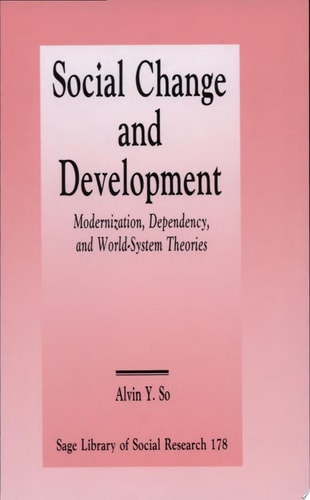
Social Change and Development: Modernization, Dependency and World-System Theories
0
0
As an Amazon Associate and affiliate partner, Menrva Books earns from qualifying purchases. Learn more
Author Description
During the past four decades, the field of development has been dominated by three schools of research. The 1950s saw the modernization school, the 1960s experienced the dependency school, the 1970s developed the new world-system school, and the 1980s is a convergence of all three schools. Alvin Y. So examines the dynamic nature of these schools of development--what each of them represents, their contributions, how they have criticized each other, how they have defended themselves, and how they were transformed. He reviews a variety of empirical studies, focusing on the "classical" and the "new" models, to show how each of the perspectives affects the study of development. In addition, this book features a unique emphasis on the research implications of the three perspectives, involving changes in orientation, agenda, methodology, and findings. Social Change and Development is the first study that compares the strengths and weaknesses of the three schools of development in a thorough, comprehensive manner. It will be of great interest to students and professionals in urban studies, development studies, political science and comparative politics.
Menrva's Summary
THE THESIS
This book investigates the evolution and interrelationships of three dominant theoretical schools in development studies: modernization, dependency, and world-system theories. Alvin Y. So, an expert in the field, meticulously examines the core tenets, contributions, and mutual criticisms of each school. The book traces their development from the 1950s through the 1980s, highlighting how they have converged and transformed over time. So employs a range of empirical studies, distinguishing between classical and new models to illustrate the impact of each perspective on development research and its implications for research orientation, agenda, methodology, and findings.
THE SCOPE MAP
- Detailed examination of Modernization Theory (1950s).
- In-depth analysis of Dependency Theory (1960s).
- Comprehensive review of World-System Theory (1970s).
- Discussion of the convergence of these three schools in the 1980s.
- Comparison of classical and new models within each theoretical perspective.
- Analysis of empirical studies to illustrate theoretical applications.
- Focus on research implications: changes in orientation, agenda, methodology, and findings.
THE AUTHORITY PERSPECTIVE
The book is highly recommended by Development Update, which notes its value for both beginners and serious students of development, as highlighted by the Indian Journal of Public Administration. Immanuel Wallerstein states the book will fill a needed niche better than anything heretofore, and Winston Davis describes it as a remarkable piece of work that will be of great service to teachers and students. Professor So is praised for providing an excellent review of the three major theories, skillfully presenting early expressions, major criticisms, and recent expressions that incorporate those criticisms.
Page Count:
283
Publication Date:
1990-03-01
Publisher:
SAGE
ISBN-10:
0803935471
ISBN-13:
9780803935471
History
Politics
Non-Fiction
Sociology
Urban Studies