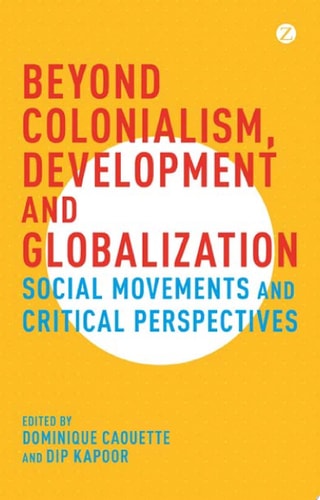
Beyond Colonialism, Development and Globalization
0
0
As an Amazon Associate and affiliate partner, Menrva Books earns from qualifying purchases. Learn more
Author Description
Development studies is in a state of flux. A new generation of scholars has come to reject what was once regarded as accepted wisdom, and increasingly regard development and globalization as part of a continuum with colonialism, premised on the same reductionist assumption that progress and growth are objective facts that can be fostered, measured, assessed and controlled. Drawing on a variety of theoretical perspectives and approaches, this book explores the ways in which social movements in the Global South are rejecting Western-centric notions of development and modernization, as well as creating their own alternatives. By assessing development theories from the perspective of subaltern groups and movements, the contributors posit a new notion of development 'from below', one in which these movements provide new ways of imagining social transformation, and a way out of the 'developmental dead end' that has so far characterized post-development approaches. Beyond Colonialism, Development and Globalization therefore represents a radical break with the prevailing narrative of modernization, and points to a bold new direction for development studies.
Menrva's Summary
THE THESIS
This book challenges the prevailing paradigms of development studies by examining how social movements in the Global South are actively rejecting Western-centric notions of progress and modernization. The authors and contributors explore the continuum between colonialism, development, and globalization, arguing that these concepts are often premised on reductionist assumptions of measurable growth. By assessing development theories from the perspective of subaltern groups, the book posits a new notion of development 'from below,' offering alternative pathways for social transformation and a critique of post-development approaches.
THE SCOPE MAP
- Critique of Western-centric development theories
- Analysis of social movements in the Global South
- Exploration of the continuum between colonialism, development, and globalization
- Introduction of a 'development from below' concept
- Reimagining social transformation beyond modernization narratives
- Assessment of post-development approaches
THE AUTHORITY PERSPECTIVE
The book is positioned as a radical departure from traditional modernization narratives, aiming to redirect the field of development studies. It seeks to provide new ways of imagining social transformation by centering the perspectives of subaltern groups and movements. The contributors' work suggests a move towards a more nuanced understanding of development that acknowledges and incorporates diverse, non-Western-centric alternatives. This approach offers a potential way out of what the book terms the 'developmental dead end' of some existing theories.
Page Count:
306
Publication Date:
2015-12-15
Publisher:
Bloomsbury UK
ISBN-10:
1783605863
ISBN-13:
9781783605866
Politics
History
Non-Fiction
Global South
Globalization
Community Tags
Similar Books