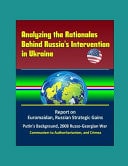
Analyzing the Rationales Behind Russia's Intervention in Ukraine: Report on Euromaidan, Russian Strategic Gains, Putin's Background, 2008 Russo-Georgian War, Communism to Authoritarianism, and Crimea
0
0
As an Amazon Associate and affiliate partner, Menrva Books earns from qualifying purchases. Learn more
Author Description
This study examines the rationales behind Russian President Vladimir Putin's decision to intervene in Ukraine through the lenses of neoclassical realism and prospect theory. The risk-acceptant decision to employ hybrid warfare in Crimea was fundamentally due to Putin's loss aversion. Since Putin frames his political decisionmaking reference point in the realm of losses, his decision sought to prevent the imminent losses of Ukraine's Russian-oriented government, Russia's influence in Ukraine, and Putin's own political power at home. It also sought to somewhat recover from the "catastrophic" loss of the Soviet Union's territorial possessions, population, and status. Putin exploited Western leaders' naivete and vulnerabilities to prepare a geopolitical landscape wherein Russia could act without incurring excessive costs. Emboldened by Russia's large financial reserves and backed by Russia's seemingly irrational threats of cutting off essential European gas supplies and launching nuclear attacks, Putin correctly anticipated a limited economic sanctions response and a negligible military response from the West. Putin's decision furthered Russia's interests by acquiring Crimea, the strategically indispensable port of Sevastopol, and vast Black Sea region resources. Such action also thwarted the expansion of Western institutions in Ukraine and incited fervent Russian ethno-nationalism, boosting Putin's domestic approval ratings to an unprecedented level. CHAPTER I - INTRODUCTION * A. UKRAINIAN EUROMAIDAN AND RUSSIAN INTERVENTION * B. LITERATURE REVIEW: RETURN TO REALISM? * 1. Neorealism and Neoclassical Realism * a. Offensive Realism * b. Defensive Realism * c. Balance of Interests Theory * 2. Contemporary Realist Arguments * a. Spheres of Interest * b. Critiques of Realist Arguments * C. THE DECISION TO INTERVENE * 1. Rational Rationale * 2. Prospect Theory * D. POTENTIAL EXPLANATIONS AND HYPOTHESIS * CHAPTER II - RUSSIA'S STRATEGIC GAINS * A. POST-SOVIET UKRAINE IN CONTE
Menrva's Summary
THE THESIS
This report investigates the multifaceted rationales underpinning Russia's intervention in Ukraine, analyzing key historical events and theoretical frameworks. The study employs neoclassical realism and prospect theory to dissect President Vladimir Putin's decision-making, particularly his risk-acceptant use of hybrid warfare in Crimea, which is attributed to loss aversion and a desire to prevent perceived losses of influence and power. The report details how Putin leveraged Western naivete and Russia's financial strength, coupled with strategic threats, to minimize anticipated costs from sanctions and military responses, ultimately advancing Russia's geopolitical interests through the acquisition of Crimea and thwarting Western institutional expansion.
THE SCOPE MAP
- Analysis of the Ukrainian Euromaidan and its connection to Russian intervention.
- Literature review focusing on realist international relations theories, including neorealism, neoclassical realism, offensive realism, defensive realism, and balance of interests theory.
- Examination of contemporary realist arguments such as spheres of interest and critiques thereof.
- Detailed breakdown of the decision-making process, including rationales and the application of prospect theory.
- Exploration of potential explanations and hypotheses regarding Russia's actions.
- Assessment of Russia's strategic gains, including the acquisition of Crimea and Sevastopol.
- Discussion of the post-Soviet geopolitical landscape concerning Ukraine and Russia's influence.
THE AUTHORITY PERSPECTIVE
This report, authored by entities within the U.S. Department of Defense, offers a detailed analysis of the strategic and political motivations behind Russia's intervention in Ukraine. It draws upon established international relations theories to frame President Putin's decision-making, particularly highlighting the role of loss aversion and the pursuit of strategic gains. The work is structured to provide a comprehensive overview, beginning with the Euromaidan events and progressing through theoretical frameworks to an assessment of Russia's outcomes. The inclusion of chapter outlines suggests a systematic and in-depth examination of the subject matter.
Page Count:
112
Publication Date:
2017-10-30
Publisher:
Amazon Digital Services LLC - KDP Print US
ISBN-10:
1973189739
ISBN-13:
9781973189732
Politics
Non-Fiction
History
Geopolitics
International relations
Russian History
Military History
Community Tags
Similar Books



Reader Comments
Share Your Thoughts
No comments yet. Be the first to share your thoughts!