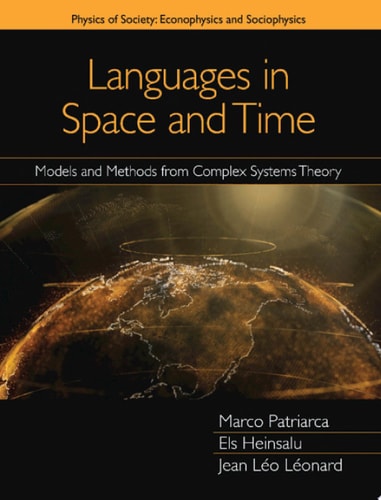
Languages in Space and Time Models and Methods from Complex Systems Theory
0
0
As an Amazon Associate and affiliate partner, Menrva Books earns from qualifying purchases. Learn more
Author Description
This cross-disciplinary volume provides an overview of how complexity theory and the tools of statistical mechanics can be applied to linguistic problems to help reveal language groups, and to model the evolution and competition of languages in space and time. Illustrated with a series of case studies and worked examples, it presents an interdisciplinary framework to enable researchers from the mathematical, physical and social sciences to collaborate on linguistic problems. It demonstrates the complexity of linguistic databases and provides a mathematical toolkit for analyzing and extracting useful information from them - helping to conceptualize empirical facts better than a mere ethnographic view. Providing an important bridge to facilitate collaboration between linguists and mathematical modelers, this book will stimulate new ideas and avenues for research, and will form a valuable resource for advanced students and academics working across complex systems, sociolinguistics, and language dynamics.
Menrva's Summary
THE THESIS
This volume investigates the application of complexity theory and statistical mechanics to linguistic problems to reveal language groups and model their evolution. The authors, drawing from mathematical, physical, and social sciences, present an interdisciplinary framework for analyzing linguistic databases. The book demonstrates how these tools can extract valuable information, offering a more quantitative approach than traditional ethnographic methods. It aims to foster collaboration between linguists and mathematical modelers, stimulating new research avenues.
THE SCOPE MAP
- Application of complexity theory to linguistic data
- Tools from statistical mechanics for language analysis
- Modeling language evolution and competition in space and time
- Case studies and worked examples
- Interdisciplinary framework for collaboration
- Mathematical toolkit for analyzing linguistic databases
THE AUTHORITY PERSPECTIVE
This book is positioned as a valuable resource for advanced students and academics working across complex systems, sociolinguistics, and language dynamics. It aims to provide a mathematical toolkit for analyzing linguistic databases, offering a conceptual bridge between linguists and mathematical modelers. The work is expected to stimulate new ideas and research by presenting an interdisciplinary framework and demonstrating the utility of quantitative methods in understanding language.
Page Count:
202
Publication Date:
2020-10-29
Publisher:
Cambridge University Press
ISBN-10:
1108868525
ISBN-13:
9781108868525
Science
Non-Fiction
Mathematical Modeling
Statistical mechanics
Linguistics
Complex Systems
Community Tags
Similar Books