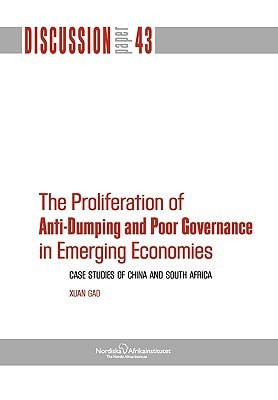
The Proliferation of Anti-dumping and Poor Governance in Emerging Economies: Case Studies of China and South Africa
0
0
As an Amazon Associate and affiliate partner, Menrva Books earns from qualifying purchases. Learn more
Author Description
Through examination of the alleged rationale of the anti-dumping (AD) instrument, this paper argues that it has little to do with fairness or with level playing fields. AD trade protection enjoys broad political support merely because its convoluted technical complexities prevent all but a few insiders and experts from understanding the reality that underlies the rhetoric, thus enabling inefficient but well-organised domestic producers to safely utilise the instrument to protect themselves from foreign competition, at times in collusion with foreign exporters and with the national AD authorities as a broker. While the best option for AD reform, i.e., complete removal, is not practically available, this paper proposes improving AD's procedural institutions by enhancing the quality of public governance in the formulation of AD decisions by national authorities. It further examines the AD practices and laws of China and South Africa, arguing that poor governance in emerging economies contributes to their prolific use of AD, usually disproportionate to their small share of world imports. These economies already maintain higher tariff barriers than industrial countries, so that without effective steps to ensure better governance to restrain the arbitrary and proliferating use of AD, they may lose out significantly on the gains from the trade liberalisation for which they have been striving for decades. Xuan Gao is a PhD candidate under Professor Asif H. Qureshi's supervision, at the School of Law, University of Manchester. He is also an assistant editor for Manchester Journal of International Economic Law, and for Routledge Publishing Group on the book project "Critical Concepts in International Economic Law". His main field of research interest is International Trade Law and public governance.
Menrva's Summary
THE THESIS
This paper investigates the anti-dumping (AD) instrument, arguing it is primarily a tool for protectionism rather than fairness. The author contends that the complexity of AD regulations allows inefficient domestic producers to shield themselves from foreign competition, sometimes with the complicity of foreign exporters and national authorities. While complete removal of AD is not feasible, the paper proposes enhancing procedural institutions and public governance in AD decision-making. It specifically examines the practices in China and South Africa, highlighting how poor governance in these emerging economies leads to prolific and disproportionate use of AD, potentially undermining trade liberalization gains.
THE SCOPE MAP
- Analysis of the alleged rationale behind the anti-dumping (AD) instrument.
- Argument that AD trade protection is driven by political support due to its technical complexity.
- Examination of how AD enables inefficient domestic producers to gain protection from foreign competition.
- Discussion of potential collusion between domestic producers, foreign exporters, and national AD authorities.
- Proposal for improving AD's procedural institutions by enhancing public governance quality.
- Case studies of AD practices and laws in China and South Africa.
- Argument that poor governance in emerging economies contributes to the prolific use of AD.
- Analysis of how AD use in these economies is often disproportionate to their share of world imports.
THE AUTHORITY PERSPECTIVE
The paper's analysis suggests a critical perspective on the anti-dumping instrument, framing it as a mechanism for protectionism rather than fair trade. The focus on procedural improvements and governance quality indicates an academic approach aimed at policy reform within international trade law. The examination of China and South Africa points to a comparative study highlighting the challenges faced by emerging economies in managing trade policies effectively. The author's background as a PhD candidate and editor suggests a scholarly contribution to the field of international economic law.
Page Count:
48
Publication Date:
2009-01-01
Publisher:
Nordiska Afrikainstitutet
ISBN-10:
9171066446
ISBN-13:
9789171066442
Economics
Non-Fiction
Case studies
Governance
Community Tags
Similar Books