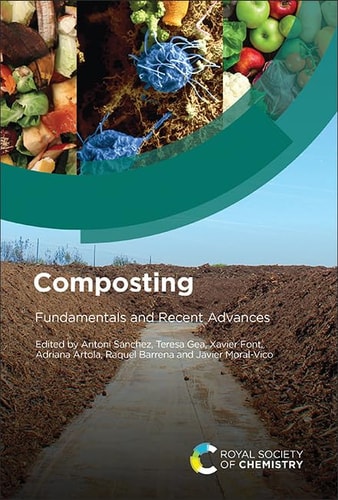
Composting Fundamentals and Recent Advances
0
0
As an Amazon Associate and affiliate partner, Menrva Books earns from qualifying purchases. Learn more
Author Description
Every year a huge amount of organic solid waste is generated globally. This quantity is expected to keep increasing, making sustainable, safe and environmentally responsible management of solid waste vitally important. Composting offers a circular and low-impact route to managing and treating organic solid waste and produces a nutrient rich medium with uses in horticulture and agriculture. Beginning with a solid introduction to the fundamentals of composting, including bioreactor engineering, energy and mass transfer issues and microbiology, this book then moves on to more complex topics such as compost stability, gaseous emissions and compost uses. With a focus on sustainability, the role of composting in biorefineries and how composting can complement other technologies such as anaerobic digestion and solid-state fermentation are also discussed. This book is a great resource for both students and researchers with an interest in organic waste management, sustainability or the circular economy.
Menrva's Summary
THE THESIS
This book investigates the critical role of composting in managing the escalating global generation of organic solid waste. It begins by establishing foundational principles of composting, including bioreactor engineering, microbiology, and transfer phenomena, before delving into advanced topics such as compost stability, emissions, and diverse applications. The authors emphasize sustainability, exploring composting's integration within biorefineries and its synergy with other waste treatment technologies like anaerobic digestion and solid-state fermentation, offering a comprehensive resource for students and researchers in organic waste management and the circular economy.
THE SCOPE MAP
- Fundamentals of composting, including bioreactor engineering
- Energy and mass transfer issues in composting
- Microbiology of the composting process
- Compost stability and assessment methods
- Gaseous emissions from composting and their control
- Applications of compost in horticulture and agriculture
- Composting within biorefinery concepts
- Integration of composting with anaerobic digestion and solid-state fermentation
THE AUTHORITY PERSPECTIVE
This book is positioned as a comprehensive resource for students and researchers focused on organic waste management, sustainability, and the circular economy. Its structure, moving from fundamental principles to advanced topics and integrated systems, suggests a thorough and systematic approach to the subject matter. The inclusion of topics like bioreactor engineering and the synergy with other waste treatment technologies indicates a focus on both theoretical understanding and practical application within modern waste management strategies.
Page Count:
522
Publication Date:
2025-04-25
Publisher:
Royal Society of Chemistry
ISBN-10:
1837671621
ISBN-13:
9781837671625
Non-Fiction
Science
Horticulture
Agriculture
Community Tags
Similar Books














