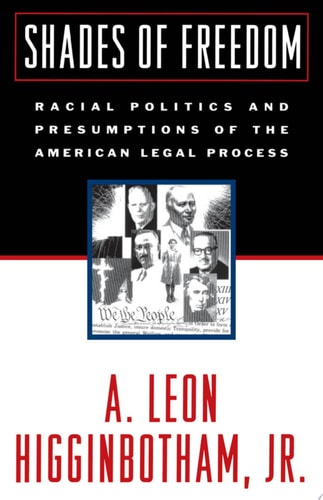
Shades of Freedom: Racial Politics and Presumptions of the American Legal Process
0
0
As an Amazon Associate and affiliate partner, Menrva Books earns from qualifying purchases. Learn more
Author Description
Few individuals have had as great an impact on the law--both its practice and its history--as A. Leon Higginbotham, Jr. A winner of the Presidential Medal of Freedom, the nation's highest civilian honor, he has distinguished himself over the decades both as a professor at Yale, the University of Pennsylvania, and Harvard, and as a judge on the United States Court of Appeals. But Judge Higginbotham is perhaps best known as an authority on racism in America: not the least important achievement of his long career has been In the Matter of Color, the first volume in a monumental history of race and the American legal process. Published in 1978, this brilliant book has been hailed as the definitive account of racism, slavery, and the law in colonial America.Now, after twenty years, comes the long-awaited sequel. In Shades of Freedom, Higginbotham provides a magisterial account of the interaction between the law and racial oppression in America from colonial times to the present, demonstrating how the one agent that should have guaranteed equal treatment before the law--the judicial system--instead played a dominant role in enforcing the inferior position of blacks. The issue of racial inferiority is central to this volume, as Higginbotham documents how early white perceptions of black inferiority slowly became codified into law. Perhaps the most powerful and insightful writing centers on a pair of famous Supreme Court cases, which Higginbotham uses to portray race relations at two vital moments in our history. The Dred Scott decision of 1857 declared that a slave who had escaped to free territory must be returned to his slave owner. Chief Justice Roger Taney, in his notorious opinion for the majority, stated that blacks were "so inferior that they had no right which the white man was bound to respect." For Higginbotham, Taney's decision reflects the extreme state that race relations had reached just before the Civil War. And after the War and Reconstruction, Higginbotham
Menrva's Summary
THE THESIS
This volume investigates how the American judicial system transitioned from a neutral arbiter of justice into a primary instrument for codifying and enforcing racial inferiority. A. Leon Higginbotham Jr., a distinguished jurist and legal scholar, utilizes his extensive background in the federal court system and academia to construct a rigorous historical analysis. He argues that the legal framework of the United States did not merely fail to protect Black citizens but actively participated in the institutionalization of racial oppression from the colonial era through the post-Civil War period.
THE SCOPE MAP
What You Will Find
- Historical analysis of the interaction between American law and racial oppression.
- Detailed examination of the Dred Scott decision and its impact on legal definitions of citizenship.
- Documentation of how societal perceptions of racial inferiority were translated into formal statutes.
- Critical evaluation of the role of the judiciary during the Reconstruction era.
THE AUTHORITY PERSPECTIVE
Legal scholars and historians frequently cite this work as a foundational text for understanding the intersection of systemic racism and constitutional law. Experts highlight the author's ability to synthesize complex judicial opinions into a clear narrative regarding the evolution of American racial politics.
Page Count:
352
Publication Date:
1996-10-24
Publisher:
Oxford University Press
ISBN-10:
0195038223
ISBN-13:
9780195038224
History
Civil Rights
Law
Segregation
African Americans
United States
Sociology
Community Tags
Other Editions(2)

Similar Books




Reader Comments
Share Your Thoughts
No comments yet. Be the first to share your thoughts!