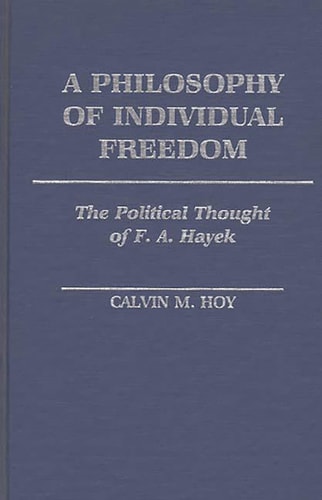
A Philosophy of Individual Freedom: The Political Thought of F. A. Hayek
0
0
As an Amazon Associate and affiliate partner, Menrva Books earns from qualifying purchases. Learn more
Author Description
In this incisive work, Calvin M. Hoy focuses exclusively on Hayek's philosophy of individual freedom. Beginning with an analysis of Hayek's definition of freedom, the author examines his proposed methods for preserving personal liberty through economic, legal, and governmental measures, and provides a trenchant critique of Hayek's arguments. Ultimately, Hoy demonstrates that a minimal socialist state is compatible with Hayek's principles, and that Hayek has not successfully stated a comprehensive philosophy of freedom because he focuses on the type and ignores the amount of coercion permissible in a free society.
Menrva's Summary
THE THESIS
This work meticulously dissects Friedrich Hayek's philosophy of individual freedom, examining its core tenets and practical applications. Calvin M. Hoy delves into Hayek's definition of liberty, exploring the economic, legal, and governmental mechanisms Hayek proposed to safeguard personal autonomy. The analysis further includes a critical evaluation of Hayek's arguments, ultimately contending that a minimal socialist state can coexist with his principles. Hoy's central argument posits that Hayek's philosophy is incomplete because it prioritizes the type of coercion over its permissible amount in a free society.
THE SCOPE MAP
- Analysis of F. A. Hayek's definition of freedom.
- Examination of economic measures for preserving personal liberty.
- Exploration of legal measures for preserving personal liberty.
- Discussion of governmental measures for preserving personal liberty.
- Critique of Hayek's arguments regarding freedom and coercion.
- Argument for the compatibility of a minimal socialist state with Hayek's principles.
- Assessment of the comprehensiveness of Hayek's philosophy of freedom.
THE AUTHORITY PERSPECTIVE
This book is regarded as a focused and critical examination of F. A. Hayek's contributions to the philosophy of individual freedom. The author's detailed analysis and critique offer a specific perspective on the compatibility of Hayek's ideas with different political structures. The work is likely to appeal to scholars and students of political philosophy and economics interested in a nuanced debate on liberty and coercion.
Page Count:
144
Publication Date:
1984-12-19
Publisher:
Holtzbrinck
ISBN-10:
0313243611
ISBN-13:
9780313243615
Economics
Politics
Philosophy
Non-Fiction
Political Philosophy
Liberalism
Individualism
Community Tags
Similar Books