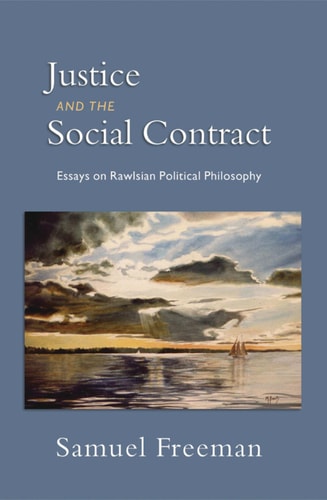
Justice and the Social Contract: Essays on Rawlsian Political Philosophy
0
0
As an Amazon Associate and affiliate partner, Menrva Books earns from qualifying purchases. Learn more
Author Description
John Rawls (1921-2002) was one of the 20th century's most important philosophers and continues to be among the most widely discussed of contemporary thinkers. His work, particularly A Theory of Justice, is integral to discussions of social and international justice, democracy, liberalism, welfare economics, and constitutional law, in departments of philosophy, politics, economics, law, public policy, and others. Samuel Freeman is one of Rawls's foremost interpreters. This volume contains nine of his essays on Rawls and Rawlsian justice, two of which are previously unpublished. Freeman places Rawls within historical context in the social contract tradition, addresses criticisms of his positions, and discusses the implications of his views on issues of distributive justice, liberalism and democracy, international justice, and other subjects. This collection will be useful to the wide range of scholars interested in Rawls and theories of justice.
Menrva's Summary
THE THESIS
This volume investigates the core tenets of John Rawls’s political philosophy and their ongoing relevance to contemporary debates on justice and the social contract. Samuel R. Freeman, a prominent scholar and interpreter of Rawls, compiles nine essays that analyze the historical foundations of Rawlsian thought. The work addresses common criticisms while exploring the practical implications of these theories for modern democracy, distributive justice, and international relations.
THE SCOPE MAP
What You Will Find
- Analysis of the social contract tradition in historical context
- Examinations of distributive justice and welfare economics
- Discussions on the intersection of liberalism, democracy, and constitutional law
- Two previously unpublished essays on Rawlsian theory
Scope Limits
- The text focuses primarily on Rawlsian frameworks and does not provide a comprehensive history of all political philosophy
- It assumes a baseline familiarity with academic political theory
THE AUTHORITY PERSPECTIVE
Scholars and students of political philosophy frequently identify this collection as a significant resource for understanding the nuances of Rawlsian thought. Experts highlight Freeman’s ability to bridge the gap between abstract theory and practical application in law and public policy.
Page Count:
354
Publication Date:
2006-01-01
Publisher:
Oxford University Press
ISBN-10:
0190293837
ISBN-13:
9780190293833
Philosophy
Ethics
History & Surveys
Political Philosophy
Social justice
Liberalism
Community Tags
Similar Books