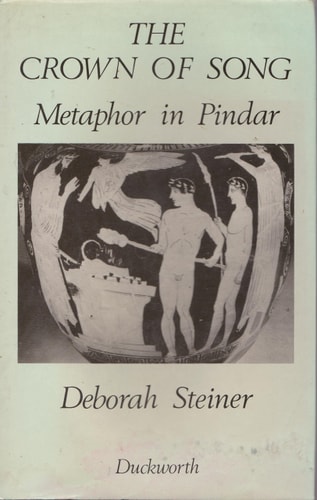
Crown of Song: Metaphor in Pindar
0
0
As an Amazon Associate and affiliate partner, Menrva Books earns from qualifying purchases. Learn more
Author Description
Pindar (c. 518-438 B.C.), one of ancient Greece's most famous lyric poets, is perhaps best known for his victory (epinicean) odes, written to honor the winners at various sets of games, such as the Olympiad. In Crown of Song, Deborah Steiner's study of these odes, she writes "If Pindar is remote from us in genre, his style strikes the reader as vivid and immediate. And in my reading of the epinicean odes, it is the poet's use of metaphor that accounts for the dynamic quality of his verse." Steiner begins her analysis by exploring both ancient and modern theories of metaphor, and then turns to specific imagery employed by the poet--plant life, athletics, minerals and numerous others--as a way of understanding how these metaphoric complexes function in the poet's praise of the victor, his assertion of his own place as perpetuator of the victor's immortal fame, and in his vision of human achievement and glory in the context of mortal life and immortal gods. Written in a lively, readable style, Crown of Song opens up the sometimes difficult verse of this celebrated ancient poet to modern readers.
Menrva's Summary
THE THESIS
This study investigates how Pindar’s strategic use of metaphor functions as the primary mechanism for establishing the dynamic, immortalizing quality of his epinicean odes. Deborah Steiner, a scholar of classical literature, synthesizes ancient rhetorical theory with modern linguistic analysis to examine how Pindar’s imagery—ranging from botanical to athletic motifs—constructs a bridge between mortal achievement and divine glory. By analyzing these metaphoric complexes, the author argues that Pindar does not merely praise the victor but actively positions himself as the essential architect of the victor's enduring legacy.
THE SCOPE MAP
What You Will Find
- Analysis of Pindar’s epinicean odes and their historical context within Greek athletic games.
- A comparative framework evaluating both ancient and modern theories of metaphor.
- Examination of specific imagery categories including plant life, mineralogy, and athletic competition.
- Exploration of the poet's self-referential role in perpetuating fame and human achievement.
THE AUTHORITY PERSPECTIVE
Scholars and students of classical poetry frequently cite this work as a vital resource for navigating the linguistic density of Pindar’s verse. The text is recognized for its ability to render complex ancient rhetorical structures accessible to a modern academic audience.
Page Count:
180
Publication Date:
1986-07-10
Publisher:
Oxford University Press
ISBN-10:
0195041283
ISBN-13:
9780195041286
Poetry
History
Literary Criticism
Pindar
Greek language
Metaphor
Ancient Greece
Community Tags
Similar Books