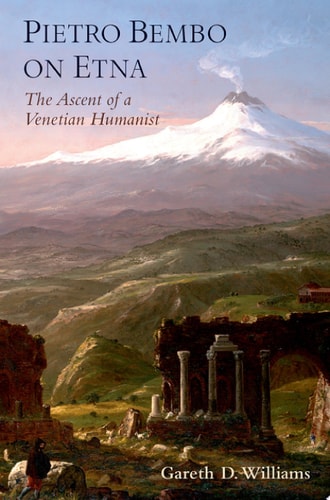
Pietro Bembo on Etna: The Ascent of a Venetian Humanist
0
0
As an Amazon Associate and affiliate partner, Menrva Books earns from qualifying purchases. Learn more
Author Description
This book is centered on the Venetian humanist Pietro Bembo (1470-1547), on his two-year stay in Sicily in 1492-4 to study the ancient Greek language under one of its most distinguished contemporary teachers, the Byzantine émigré Constantine Lascaris, and above all on his ascent of Mount Etna in 1493. The more particular focus of this study is on the imaginative capacities that crucially shape Bembo's elegantly crafted account, in Latin, of his Etna adventure in his so-called De Aetna, published at the Aldine press in Venice in 1496. This work is cast in the form of a dialogue that takes place between the young Bembo and his father Bernardo (himself a prominent Venetian statesman with strong humanist involvements) after Pietro's return to Venice from Sicily in 1494. But De Aetna offers much more than a one-dimensional account of the facts, sights and findings of Pietro's climb. Far more important in the present study is his eye for creative elaboration, or for transforming his literal experience on the mountain into a meditation on his coming-of-age at a remove from the conventional career-path expected of one of his station within the Venetian patriciate. Three mutually informing features that are critical to the artistic originality of De Aetna receive detailed treatment in this study: (i) the stimulus that Pietro drew from the complex history of Mount Etna as treated in the Greco-Roman literary tradition from Pindar onwards; (ii) the striking novelty of De Aetna's status as the first Latin text produced at the nascent Aldine press in the prototype of what modern typography knows as Bembo typeface; and (iii) Pietro's ingenious deployment of Etna as a powerful, multivalent symbol that simultaneously reflects the diverse characterizations of, and the generational differences between, father and son in the course of their dialogical exchanges within De Aetna.
Menrva's Summary
THE THESIS
This study investigates how Pietro Bembo utilized his 1493 ascent of Mount Etna to craft a complex, symbolic meditation on his personal development and identity within the Venetian patriciate. Dr. Gareth D. Williams, a scholar of classical literature, examines the intersection of Bembo's lived experience and his literary output. By analyzing the Latin dialogue De Aetna, the author argues that the text serves as more than a travelogue, functioning instead as a sophisticated exploration of generational dynamics and intellectual independence during the Italian Renaissance.
THE SCOPE MAP
What You Will Find
- Analysis of the 1492-1494 Sicilian sojourn and the influence of Constantine Lascaris.
- Examination of the literary history of Mount Etna from Pindar to the Renaissance.
- Technical history of the Aldine press and the development of the Bembo typeface.
- Literary analysis of the father-son dialogue structure within De Aetna.
Scope Limits
- The study does not provide a comprehensive biography of Pietro Bembo's entire life.
- It does not offer a general history of the Aldine press beyond its connection to this specific text.
THE AUTHORITY PERSPECTIVE
Scholars recognize this work as a precise examination of the intersection between humanist literature and the physical environment of the Renaissance. Readers frequently note the academic density of the prose, which provides a rigorous look at the intellectual climate of late 15th-century Venice.
Page Count:
437
Publication Date:
2017-01-01
Publisher:
Oxford University Press
ISBN-10:
0190683368
ISBN-13:
9780190683368
History
Biography
Ancient History
Literary Criticism
Greek language
Humanism
Description and travel
Sicily Italy
Humanities
English
English & College Success
Community Tags
Similar Books