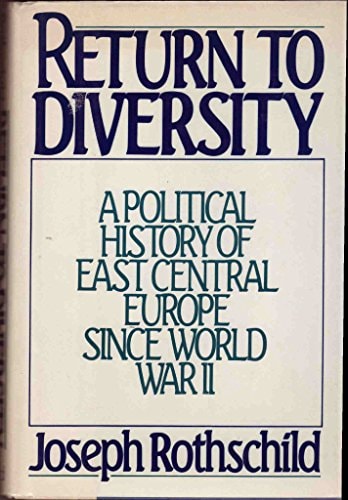
Return to Diversity: A Political History of East Central Europe Since World War II
0
0
As an Amazon Associate and affiliate partner, Menrva Books earns from qualifying purchases. Learn more
Author Description
Since the death of Stalin, the supposedly monolithic character of the Socialist states of East Central Europe has been subjected to serious and major challenges: from Yugoslavia in the late 1940s, from East Germany, Poland, and Hungary in the '50s, from Albania, Romania, and Czechoslovakia inthe '60s, from Poland in the '70s and early '80s. Written by one of the world's foremost authorities on East Central Europe, this informative study examines these challenges and their consequences in all their complexity, providing an extensive political history of the area from World War II to thepresent.A sequel to Rothschild's highly acclaimed East Central Europe Between the Two World Wars, this up-to-date volume offers a country-by-country account of the widespread political malaise in East Central Europe. Rothschild provides an insightful discussion of the Solidarity movement in Poland, a lucidanalysis of Titoism in Yugoslavia, and a thorough review of Soviet policy toward the area under all leaders since World War II. In addition, he examines the acute or impending crises in countries such as Poland and Romania, and he assesses the problems that Gorbachev faces in managing theincreasingly restive Soviet bloc nations.Unsurpassed in scope, in depth of analysis, and in fairness and objectivity, Return to Diversity is an invaluable resource for anyone interested in this vital bloc of nations.
Menrva's Summary
THE THESIS
This book investigates the political evolution and internal challenges of East Central European nations as they navigated the constraints of the Soviet bloc following World War II. Joseph Rothschild, a recognized authority on the region, utilizes a country-by-country historical framework to analyze the erosion of monolithic socialist control. By examining specific uprisings, policy shifts, and the rise of movements like Solidarity, the author argues that the region consistently sought a return to political diversity despite the pressures of Soviet hegemony.
THE SCOPE MAP
What You Will Find
- Detailed political histories of Poland, Hungary, Czechoslovakia, Yugoslavia, Romania, and East Germany.
- Analysis of the Solidarity movement and its impact on regional stability.
- Examination of Soviet foreign policy and leadership transitions from Stalin to Gorbachev.
- Comparative study of Titoism and other deviations from the Soviet model.
THE AUTHORITY PERSPECTIVE
Experts and historians frequently cite this work as a foundational text for understanding the political complexities of the Eastern Bloc during the Cold War. Readers note the dense, scholarly prose and the author's commitment to objective analysis across a wide range of national contexts.
Page Count:
272
Publication Date:
1988-11-17
Publisher:
Oxford University Press
ISBN-10:
0195045742
ISBN-13:
9780195045741
History
International relations
European History
Cold War
Eastern Europe
Community Tags
Similar Books