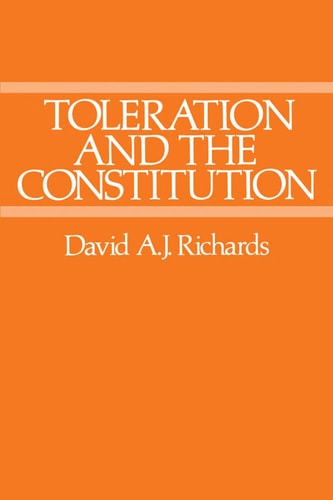
Toleration and the Constitution
0
0
As an Amazon Associate and affiliate partner, Menrva Books earns from qualifying purchases. Learn more
Author Description
Why have the issues of religious liberty, free speech and constitutional privacy come to figure so prominently in our society? What are the origins of the basic principles of our constitutional law? This work develops a general theory of constitutional interpretation based on an original synthesis of political theory, history, law, and a larger approach to the interpretation of culture. In fusing these myriad components, Professor Richards argues against the notion of "interpretivism"--the view that constitutional interpretation is concerned exclusively with the text of the Constitution and the views of its authors--and contends that the best political theory is one in which courts are permitted use contractarian theory to decide about individual rights that are immunized from majoritarian control. Presenting both historical and theoretical arguments in support of a theory that affirms the moral sovereignty of the people, Richards maintains that toleration, or respect for conscience and individual freedom, is the central constitutional ideal. He discusses such current topics of constitutional controversy as church-state relations, the scope of free speech, and the application of the constitutional right to privacy to abortion and consensual adult sexual relations.
Menrva's Summary
THE THESIS
This work investigates the origins of fundamental constitutional principles by questioning why issues of religious liberty, free speech, and privacy have become central to modern society. Professor David A. J. Richards, a legal scholar, synthesizes political theory, history, and cultural analysis to challenge the doctrine of interpretivism. He argues that constitutional interpretation should move beyond the original intent of the framers, advocating instead for a contractarian framework that protects individual rights from majoritarian influence. By positioning toleration as the core constitutional ideal, the author defends the moral sovereignty of the people in the face of contemporary legal controversies.
THE SCOPE MAP
What You Will Find
- A critique of interpretivism and originalist approaches to constitutional law.
- An application of contractarian political theory to modern judicial decision-making.
- Historical and theoretical analysis of church-state relations and free speech doctrines.
- Examination of the constitutional right to privacy regarding abortion and consensual sexual relations.
THE AUTHORITY PERSPECTIVE
Legal scholars and political theorists frequently cite this work as a significant contribution to the debate over judicial activism and constitutional interpretation. Readers often note the dense, interdisciplinary nature of the prose, which requires a foundational understanding of both legal history and political philosophy.
Page Count:
368
Publication Date:
1986-08-21
Publisher:
Oxford University Press
ISBN-10:
019504018X
ISBN-13:
9780195040180
Philosophy
History
Law
United States
Constitutional Law
Human rights
Community Tags
Other Editions(3)
Similar Books