The Tolerant Society
0
0
As an Amazon Associate and affiliate partner, Menrva Books earns from qualifying purchases. Learn more
Author Description
The First Amendment provides Americans with a far broader protection of free speech than that available in any other Western democracy, Lee Bollinger notes, and yet other democracies are not seen as significantly less open or more restrictive that the United States. Why do Americans guarantee people the right to advocate the overthrow of the government or advance racist or genocidal ideas? Why, for example, protect the right of neo-Nazis to march in predominantly Jewish Skokie, Illinois?In The Tolerant Society, Bollinger offers a masterful critique of the major theories of freedom of expression, and offers an alternative explanation. Traditional justifications for protecting extremist speech have turned largely on the inherent value of self-expression, maintaining that the benefits of the free interchange of ideas include the greater likelihood of serving truth and of promoting wise decisions in a democracy. Bollinger finds these theories persuasive but inadequate. Buttrressing his argument with references to the Skokie case and many other examples, as well as a careful analysis of the primary literature on free speech, he contends that the real value of toloeration of extremist speech lies in the extraordinary self-control toward antisocial behavior that it elicits: society is stengthened by the exercise of tolerance, he maintains. The problem of finding an appropriate response--especially when emotions make measured response difficult--is common to all social interaction, Bollinger points out, and there are useful lesons to be learned from withholding punishment even for what is conceded to be bad behavior.
Menrva's Summary
THE THESIS
This book investigates why the United States maintains a uniquely broad protection for extremist speech and whether this tolerance serves a functional purpose for democratic society. Lee C. Bollinger, a Professor of Law, examines the limitations of traditional justifications for free speech, such as the pursuit of truth or democratic decision-making. He argues that the true value of protecting offensive or antisocial speech lies in the cultivation of societal self-control and the development of a collective capacity for tolerance in the face of provocation.
THE SCOPE MAP
What You Will Find
- Analysis of the First Amendment and comparative international free speech standards.
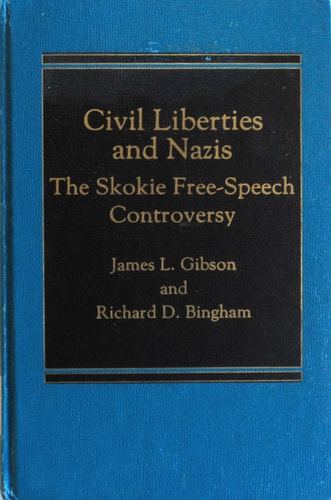
- Examination of the Skokie, Illinois neo-Nazi march case as a primary legal touchstone.
- Critique of classical free speech theories including the marketplace of ideas and self-expression models.
- A proposed framework for understanding tolerance as a mechanism for strengthening social stability.
THE AUTHORITY PERSPECTIVE
Legal scholars and political theorists frequently cite this work as a foundational text for understanding the psychological and social dimensions of free speech jurisprudence. Readers often note the academic rigor of the prose, which balances constitutional analysis with philosophical inquiry into the nature of social restraint.
Page Count:
307
Publication Date:
1986-04-10
Publisher:
Oxford University Press
ISBN-10:
0195040007
ISBN-13:
9780195040005
Philosophy
Law
Civil Rights
Sociology
Freedom of speech
Community Tags
Other Editions(2)
Similar Books