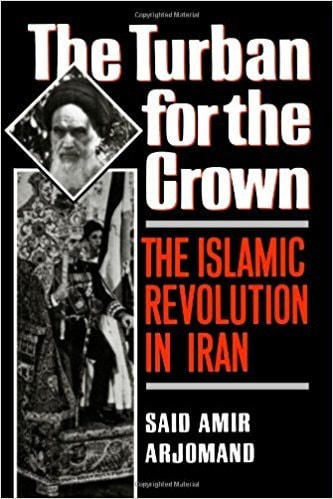
The Turban for the Crown: The Islamic Revolution in Iran
0
0
As an Amazon Associate and affiliate partner, Menrva Books earns from qualifying purchases. Learn more
Author Description
The Iranian revolution still baffles most Western observers. Few considered the rise of theocracy in a modernized state possible, and even fewer thought it might result from a popular revolution. Moreover, the Shah's well-equipped army was still intact when he fled, oil-rich Iran faced no financial crisis, and the peasantry had no part in the rebellion. In The Turban for the Crown, Said Amir Arjomand provides a thoughtful and painstakingly researched account that makes the turmoil in Iran intelligible to the general reader and that explains the import of this singular event for our understanding of revolutions.To provide crucial historical background, Arjomand traces the history of Shi'ism in Iran, ranging from its establishment as the state religion in 1501 to the ascendency of Reza Shah and the threat his creation of a modern state bureaucracy posed to Shi'ite institutions. He then describes how, when the state built by Reza Shah began to crumble, the millenarianism inherent in Shi'ism, combined with Khomeini's charismatic leadership, facilitated the emergence of Khomeini as a messianic anti-monarch...how the Shah's indecisiveness neutralized the Army and allowed the revolution to gain momentum...how the massive infusion of petrodollars into the economy--and the blatant political corruption that resulted--turned the urban middle-class against the Shah...and how Khomeini disposed of Bakhtiar, Bani-Sadr, and Bazargan, consolidated clerical rule, and established a constitution based completely on a new interpretation of Islamic principles.Unmatched in originality, historical depth, and accuracy, The Turban for the Crown is filled with insight into the Iranian revolution, the rise of Islamic fundamentalism in the Middle East, and their implications for American foreign policy.
Menrva's Summary
THE THESIS
This work investigates the paradoxical emergence of a theocratic state within a modernizing nation, specifically focusing on the causes and consequences of the 1979 Iranian Revolution. Said Amir Arjomand, a scholar of sociology and Middle Eastern studies, utilizes historical analysis and political theory to explain how the collapse of the Pahlavi monarchy facilitated the rise of clerical rule. The text argues that the revolution was not merely a reaction to economic conditions, but a complex intersection of Shi'ite institutional history, millenarian ideology, and the specific failures of the Shah's administrative state.
THE SCOPE MAP
What You Will Find
- Historical analysis of Shi'ism in Iran from 1501 to the late 20th century.
- Examination of the structural impact of Reza Shah's modern state bureaucracy on religious institutions.
- Detailed account of the political consolidation of power by Ayatollah Khomeini.
- Analysis of the role of petrodollars and urban middle-class discontent in destabilizing the monarchy.
THE AUTHORITY PERSPECTIVE
Experts frequently cite this text as a foundational academic resource for understanding the structural origins of the Iranian Revolution. Readers often note the dense, scholarly nature of the prose, which provides a rigorous framework for analyzing the intersection of religion and modern statecraft.
Page Count:
304
Publication Date:
1988-09-08
Publisher:
Oxford University Press
ISBN-10:
0195042573
ISBN-13:
9780195042573
Religion
History
Jihad
Iran
Sociology