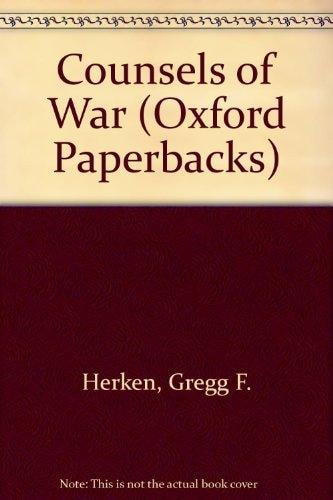
Counsels of War
0
0
As an Amazon Associate and affiliate partner, Menrva Books earns from qualifying purchases. Learn more
Author Description
Since the first atomic bomb was exploded in 1945, a close community of civilian experts, including scientists, academics, and think-tank intellectuals, has advised the American government on the prospects of nuclear war. Based on interviews with these experts, as well as hundreds of pages of recently declassified documents, Counsels of War is the first book to trace in detail the deliberations and shifting recommendations of the experts on the bomb from Hiroshima to "Star Wars."Gregg Herken writes about the people whose profession it has been to think about the unthinkable--Robert McNamara, Paul Nitze, Herman Kahn, Bernard Brodie--including their intense rivalries, personal animosities, and often contentious relationship with the professional military. He reveals how the influence of the scientist and strategist has extended well beyond the laboratory and the classroom--in the proposal of Kennedy's advisers for a nuclear "demonstration" and even a "clever first-strike" against the Russians, for example. Counsels of War also shatters certain popular assumptions about U.S. nuclear policy. As Herken points out, while American doctrine stresses "retaliation," U.S. strategists have always planned to "pre-empt" a Soviet attack.Herken shows that the lines in the current nuclear debate were actually drawn at the dawn of the atomic age, and that the experts' technically abstruse arguments have only served to hide from the public the fundamental, deeply held--and quite subjective--differences at the heart of the debate. Since Hiroshima, there has been a growing awareness of the peril created by nuclear weapons, yet the crucial questions that were never adequately addressed in 1945 unanswered today. Given the inability of the experts to confront the essential dilemma of the nuclear age, Counsels of War calls for a new nuclear debate, one focused on American rather than Soviet intentions and that seeks an answer to the fundamental, yet still unresolved question: What are these
Menrva's Summary
THE THESIS
This work investigates the historical influence and evolving strategic doctrines of the civilian experts who have advised the United States government on nuclear policy since 1945. Gregg Herken, a historian specializing in nuclear history, utilizes a combination of primary source interviews and recently declassified government documents to map the intellectual history of the nuclear age. He argues that the technical language used by these strategists often obscures subjective, deeply held ideological differences that have remained largely unaddressed since the dawn of the atomic era.
THE SCOPE MAP
What You Will Find
- Detailed analysis of U.S. nuclear strategy from the Hiroshima bombing through the Strategic Defense Initiative.
- Profiles of key civilian strategists including Robert McNamara, Paul Nitze, Herman Kahn, and Bernard Brodie.
- Examination of the contentious professional relationship between civilian think-tank intellectuals and the military establishment.
- Evidence regarding the historical shift in doctrine from public rhetoric of retaliation to internal planning for pre-emptive strikes.
THE AUTHORITY PERSPECTIVE
Experts and historians frequently cite this work as a foundational text for understanding the origins of American nuclear policy and the role of the civilian strategist. Readers often note the density of the archival research, which provides a comprehensive look at the internal debates that shaped the Cold War era.
Page Count:
448
Publication Date:
1987-07-02
Publisher:
Oxford University Press
ISBN-10:
0195049861
ISBN-13:
9780195049862
History
Nuclear weapons
International relations
Military History
Cold War
Community Tags
Other Editions(3)


Similar Books

Reader Comments
Share Your Thoughts
No comments yet. Be the first to share your thoughts!