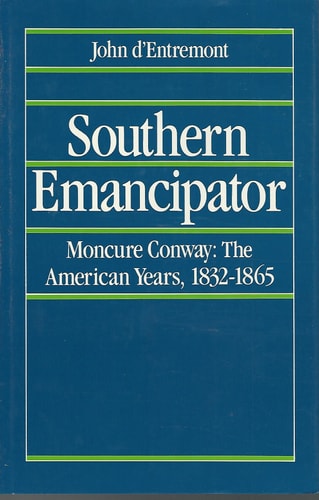
Southern Emancipator: Moncure Conway: The American Years, 1832-1865
0
0
As an Amazon Associate and affiliate partner, Menrva Books earns from qualifying purchases. Learn more
Author Description
By his thirty-third birthday, Moncure Conway was a Virginian who had abandoned the South, a minister who had rejected Christianity, an aristocrat who had embraced radical abolitionism and feminism, and one of the first American expatriates. He would live another forty-two years as an important transatlantic writer, reformer, and freethought minister, but in his American years he had already lived a lifetime and made his mark. This study of the antebellum South's most radical upper-class white male, whose life--until now--has eluded capture by historians, illuminates the demands of the antebellum Southern gentry, the nature of the abolitionist movement, the boundaries of 19th-century organized Christianity, and the tragic personal impact of the American Civil War. D'Entremont recounts Conway's dramatic career as social reformer, religious radical, and associate of such luminaries as Emerson, Wendell Phillips, Theodore Parker, Walt Whitman, and William Dean Howells. The book climaxes with the Civil War, which saw Conway, an abolitionist with two brothers in the Confederate army, agonized by his conflicting commitments to emancipation and peace. A brilliant portrayal of one of the most intriguing public figures in American history, Southern Emancipator combines important contributions to Southern history, women's history, and the history of antebellum reform and the American Civil War.
Menrva's Summary
THE THESIS
This biography investigates how Moncure Conway, a member of the Virginia gentry, transformed into a radical abolitionist and social reformer during the volatile decades preceding the American Civil War. John d'Entremont utilizes extensive archival research to trace Conway's ideological evolution from his aristocratic Southern upbringing to his eventual rejection of both his regional heritage and organized Christianity. The author argues that Conway's life serves as a unique lens through which to examine the internal contradictions of the antebellum South and the complex moral landscape of the nineteenth-century reform movement. By analyzing Conway's personal correspondence and public writings, d'Entremont illustrates the profound psychological and social costs of his commitment to emancipation.
THE SCOPE MAP
What You Will Find
- A detailed examination of the antebellum Southern gentry and the social structures that defined Conway's early life.
- An analysis of the abolitionist movement and the intellectual circles surrounding figures like Emerson and Walt Whitman.
- A study of the religious and philosophical shifts within nineteenth-century American freethought.
- An exploration of the personal and familial conflicts caused by the Civil War, specifically the divide between Conway's abolitionist stance and his brothers' service in the Confederate army.
THE AUTHORITY PERSPECTIVE
Historians recognize this work as a significant contribution to the study of Southern dissent and the intellectual history of the mid-nineteenth century. Scholars frequently cite the text for its meticulous documentation and its ability to contextualize Conway's radicalism within the broader framework of American reform.
Page Count:
304
Publication Date:
1987-07-30
Publisher:
Oxford University Press
ISBN-10:
0195042646
ISBN-13:
9780195042641
Biography
History
Abolitionism
American History
Civil War
Social Reform
Community Tags
Similar Books