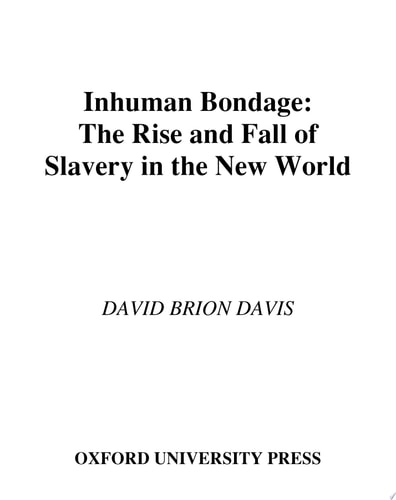
Inhuman Bondage: The Rise and Fall of Slavery in the New World
0
0
As an Amazon Associate and affiliate partner, Menrva Books earns from qualifying purchases. Learn more
Author Description
David Brion Davis has long been recognized as the leading authority on slavery in the Western World. His books have won every major history award--including the Pulitzer Prize and the National Book Award--and he has been universally praised for his prodigious research, his brilliant analytical skill, and his rich and powerful prose. Now, in Inhuman Bondage, Davis sums up a lifetime of insight in what Stanley L. Engerman calls "a monumental and magisterial book, the essential work on New World slavery for several decades to come." Davis begins with the dramatic Amistad case, which vividly highlights the international character of the Atlantic slave trade and the roles of the American judiciary, the presidency, the media, and of both black and white abolitionists. The heart of the book looks at slavery in the American South, describing black slaveholding planters, the rise of the Cotton Kingdom, the daily life of ordinary slaves, the highly destructive internal, long-distance slave trade, the sexual exploitation of slaves, the emergence of an African-American culture, and much more. But though centered on the United States, the book offers a global perspective spanning four continents. It is the only study of American slavery that reaches back to ancient foundations (discussing the classical and biblical justifications for chattel bondage) and also traces the long evolution of anti-black racism (as in the writings of David Hume and Immanuel Kant, among many others). Equally important, it combines the subjects of slavery and abolitionism as very few books do, and it illuminates the meaning of nineteenth-century slave conspiracies and revolts, with a detailed comparison with 3 major revolts in the British Caribbean. It connects the actual life of slaves with the crucial place of slavery in American politics and stresses that slavery was integral to America's success as a nation--not a marginal enterprise. A definitive history by a writer deeply immersed in the subject,
Menrva's Summary
THE THESIS
This work investigates the complex evolution, systemic integration, and eventual decline of chattel slavery within the New World, positioning it as a central pillar of American national development rather than a peripheral economic activity. David Brion Davis, a preeminent scholar in the field, synthesizes decades of archival research and historical analysis to construct a comprehensive framework. He examines the intersection of economic necessity, political maneuvering, and the philosophical justifications for bondage that persisted across centuries. By connecting the American experience to global patterns, the author argues that the institution of slavery was fundamentally woven into the fabric of Western political and social structures.
THE SCOPE MAP
What You Will Find
- A detailed examination of the Atlantic slave trade and the legal precedents set by cases such as the Amistad.
- Comparative analysis of slave revolts in the American South and the British Caribbean.
- Historical tracing of anti-black racism through the works of Enlightenment philosophers like David Hume and Immanuel Kant.
- An exploration of the daily lives of enslaved people, the rise of the Cotton Kingdom, and the political influence of slaveholding planters.
THE AUTHORITY PERSPECTIVE
Experts and historians widely recognize this text as a definitive, magisterial account of the subject that synthesizes a lifetime of scholarly inquiry. Readers frequently note the academic density of the prose, which provides a rigorous and comprehensive examination of the institution of slavery from its ancient foundations to its nineteenth-century conclusion.
Page Count:
467
Publication Date:
2006-01-01
Publisher:
Oxford University Press
ISBN-10:
0199840105
ISBN-13:
9780199840106
History
Politics
American History
Abolitionism
History of the Americas
United States
Ethnic Studies
Social History
Slavery
Community Tags
Similar Books