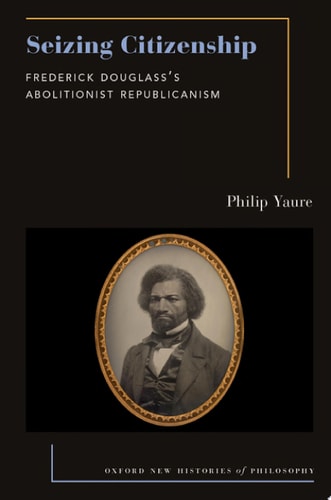
Seizing Citizenship: Frederick Douglass's Abolitionist Republicanism
0
0
As an Amazon Associate and affiliate partner, Menrva Books earns from qualifying purchases. Learn more
Author Description
In the years leading up to the U.S. Civil War, former slave and abolitionist Frederick Douglass maintained that enslaved Black Americans were already American citizens. Through a systematic analysis of his political writings from the 1840s through the 1890s, Philip Yaure shows that Douglass' declaration of Black Americans' citizenship is the locus of a profound innovation in republican political philosophy. Seizing Citizenship argues that Frederick Douglass reimagined the republican concept of citizenship, on which persons are citizens because they contribute to the polity, to cast the everyday resistance of Black Americans against slavery and white supremacy as activity that constitutes them as American citizens. The resistance of Black Americans forged them into a people with the collective power to remake America's civic ethos in a racially just and inclusive fashion. Douglass advanced an abolitionist republicanism, on which persons seize standing as free citizens of a free polity through the struggle to dismantle the oppressive institutions that dominate and exploit them. Douglass's republican politics strives not to overcome our vulnerability to one another, but instead to deepen such vulnerability on terms conducive to our shared emancipation and collective flourishing.
Menrva's Summary
THE THESIS
This book investigates how Frederick Douglass transformed the republican concept of citizenship to argue that enslaved Black Americans were already active participants in the American polity. Philip Yaure, a scholar of political philosophy, utilizes a comprehensive analysis of Douglass's writings spanning from the 1840s to the 1890s. The author argues that Douglass redefined citizenship not as a state-granted status, but as a condition forged through the active resistance of Black Americans against slavery and systemic white supremacy. By framing this resistance as a foundational civic act, Yaure demonstrates how Douglass developed a unique form of abolitionist republicanism that centers on collective struggle and shared emancipation.
THE SCOPE MAP
What You Will Find
- A systematic examination of Frederick Douglass's political writings from the 1840s through the 1890s.
- A theoretical framework defining abolitionist republicanism as a response to institutional domination.
- An analysis of how everyday resistance functions as a mechanism for establishing civic standing.
- A reinterpretation of republican political philosophy regarding vulnerability and collective flourishing.
THE AUTHORITY PERSPECTIVE
Scholars in political theory and American history recognize this work as a significant contribution to the study of Douglass's intellectual legacy. Readers frequently note the academic density of the prose, which provides a rigorous philosophical grounding for understanding the intersection of abolitionism and republican thought.
Page Count:
224
Publication Date:
2025-07-17
Publisher:
Oxford University Press
ISBN-10:
0197776736
ISBN-13:
9780197776735
History
Philosophy
Politics
Social Philosophy
Individual Philosophers
Political Philosophy
American History
Abolitionism
Community Tags
Similar Books