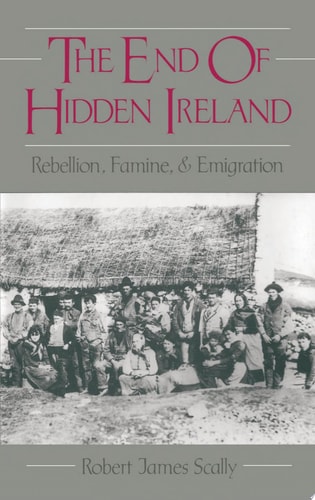
The End of Hidden Ireland: Rebellion, Famine, and Emigration
0
0
As an Amazon Associate and affiliate partner, Menrva Books earns from qualifying purchases. Learn more
Author Description
Many thousands of Irish peasants fled from the country in the terrible famine winter of 1847-48, following the road to the ports and the Liverpool ferries to make the dangerous passage across the Atlantic. The human toll of "Black '47," the worst year of the famine, is notorious, but the lives of the emigrants themselves have remained largely hidden, untold because of their previous obscurity and deep poverty. In The End of Hidden Ireland, Scally brings their lives to light. Focusing on the townland of Ballykilcline in Roscommon, Scally offers a richly detailed portrait of Irish rural life on the eve of the catastrophe. From their internal lives and values, to their violent conflict with the English Crown, from rent strikes to the potato blight, he takes the emigrants on each stage of their journey out of Ireland to New York. Along the way, he offers rare insights into the character and mentality of the immigrants as they arrived in America in their millions during the famine years. Hailed as a distinguished work of social history, this book also is a tale of adventure and human survival, one that does justice to a tragic generation with sympathy but without sentiment.
Menrva's Summary
THE THESIS
How did the socioeconomic collapse of a specific Irish townland during the Great Famine reshape the lives and mentalities of the peasants who fled to America? Robert Scally, a historian specializing in Irish rural life, utilizes primary records and local archives to reconstruct the existence of the inhabitants of Ballykilcline. He argues that the transition from rural Irish life to the immigrant experience in New York represents a fundamental rupture in the social fabric of the 19th-century Irish peasantry.
THE SCOPE MAP
What You Will Find
- A micro-historical analysis of the townland of Ballykilcline in County Roscommon.
- Documentation of the transition from agrarian life to the trauma of the Great Famine.
- Examination of the political and economic conflicts between Irish tenants and the English Crown.
- Insights into the psychological and cultural adaptation of famine-era immigrants in New York.
THE AUTHORITY PERSPECTIVE
Historians and scholars of Irish studies frequently cite this work for its meticulous archival research and its ability to humanize the statistical data of the Great Famine. Readers often note the academic density of the prose, which provides a rigorous look at the social structures of the period.
Page Count:
288
Publication Date:
1995-03-02
Publisher:
Oxford University Press
ISBN-10:
0195055829
ISBN-13:
9780195055825
History
Ireland
19th Century
Famine
European History
Villages
Famines
Country Life
Irish History
Social History
Community Tags
Other Editions(2)
Similar Books