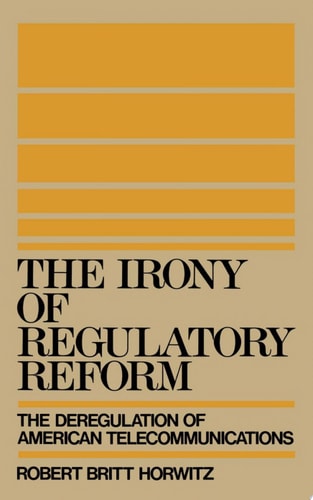
The Irony of Regulatory Reform: The Deregulation of American Telecommunications
0
0
As an Amazon Associate and affiliate partner, Menrva Books earns from qualifying purchases. Learn more
Author Description
Deregulation was a political buzzword of the early 1980's. The Reagan Administration came to power on a platform dedicated to getting government "off the backs of the people." Deregulation promised to lower inflation, raise productivity, and reverse the sagging fortunes of American industry. And proponents declared deregulation morally right because it constituted a rollback of the arbitrary power of the state in favor of individual initiative and liberty. But the actual politics of deregulation, including the momentous breakup of AT&T, had already turned out to be far more complex than this rhetoric suggested. In The Irony of Regulatory Reform Horwitz examines the history of telecommunications--both telephone and broadcast--to build a compelling new theory of regulation. Against the backdrop of modern theories of the state, he presents a sweeping survey of the history of regulation in America, delineating three distinct periods of regulatory genesis and, correspondingly, three discrete types of agencies. Horwitz shows the underlying irony that while anti-regulation rhetoric was aimed at the so-called "social" regulatory agencies, in practice it has been the "economic" agencies that have been deregulated, often with vehement opposition from the industries affected. Within the context of this broader theory, telecommunications is a fascinating industry to study, because it determines the character of our marketplace of ideas, because it has been an arena of great technological transformation, and because of its fundamental role in anchoring the so-called "information age." Horwitz unveils the complex mosaic of forces--economic, political, legal, and technological--that undermined the traditional regulation of telecommunications and precipitated deregulation.
Menrva's Summary
THE THESIS
This book investigates the fundamental contradiction between the political rhetoric of deregulation and the actual outcomes of regulatory reform within the American telecommunications sector. Robert Britt Horwitz, a scholar of communication and political economy, utilizes historical analysis and political theory to challenge the simplistic narrative that deregulation merely represents a reduction of state power. By examining the evolution of regulatory agencies, he argues that the process is driven by a complex interplay of economic interests and political maneuvering rather than a straightforward commitment to free-market ideology.
THE SCOPE MAP
What You Will Find
- A detailed historical survey of American telecommunications regulation covering both telephone and broadcast sectors.
- A theoretical framework categorizing three distinct periods of regulatory genesis and agency types.
- An analysis of the political and economic forces that led to the breakup of AT&T.
- A critical examination of the shift from social to economic regulatory agency oversight.
THE AUTHORITY PERSPECTIVE
Scholars and policy analysts recognize this work as a foundational text for understanding the political economy of the information age. Readers frequently note the academic density of the prose, which provides a rigorous, evidence-based critique of 1980s regulatory policy.
Page Count:
424
Publication Date:
1988-12-15
Publisher:
Oxford University Press
ISBN-10:
0195054458
ISBN-13:
9780195054453
Economics
History
Telecommunications
United States
Public Policy
Community Tags
Similar Books