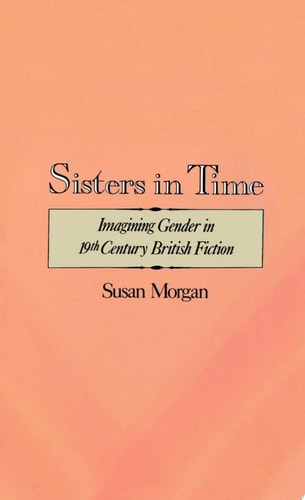
Sisters in Time: Imagining Gender in Nineteenth-century British Fiction
0
0
As an Amazon Associate and affiliate partner, Menrva Books earns from qualifying purchases. Learn more
Author Description
Asking why the 19th-century British novel features heroines, and how and why it features "feminine heroism," Susan Morgan traces the relationship between fictional depictions of gender and Victorian ideas of history and progress. Morgan approaches gender in selected 19th-century British novels as an imaginative category, accessible to authors and characters of either sex. Arguing that conventional definitions of heroism offer a fixed and history-denying perspective on life, the book traces a literary tradition that represents social progress as a process of feminization. The capacities for flexibility, mercy, and self-doubt, conventionally devalued as feminine, can make it possible for characters to enter history. She shows that Austen and Scott offer revolutionary definitions of feminine heroism, and the tradition is elaborated and transformed by Gaskell, Eliot, Meredith, and James (partly through one of his last "heroines," the aging hero of The Ambassadors.) Throughout the study, Morgan considers how gender functions both in individual novels and more extensively as a means of tracing larger patterns and interests, especially those concerned with the redemptive possibilities of a temporal and historical perspective.
Menrva's Summary
THE THESIS
This book investigates how nineteenth-century British novelists utilized the concept of feminine heroism to challenge static historical narratives and redefine the nature of social progress. Susan Morgan, a scholar of Victorian literature, examines the intersection of gender roles and historical consciousness within the works of major authors. She argues that traits traditionally labeled as feminine—such as flexibility, mercy, and self-doubt—are presented by these writers as essential mechanisms for characters to engage with and influence the flow of history. By analyzing the evolution of these tropes, the text posits that the nineteenth-century novel functions as a site for reimagining the relationship between individual identity and temporal change.
THE SCOPE MAP
What You Will Find
- Analysis of gender as an imaginative category rather than a biological constraint.
- Examination of the works of Jane Austen, Walter Scott, Elizabeth Gaskell, George Eliot, George Meredith, and Henry James.
- Exploration of the literary tradition that equates social progress with the process of feminization.
- Discussion of how conventional definitions of heroism are critiqued for being history-denying.
THE AUTHORITY PERSPECTIVE
Scholars and critics recognize this work as a significant contribution to the study of Victorian narrative structures and gender theory. Readers frequently note the academic density of the prose, which provides a rigorous framework for understanding the evolution of the nineteenth-century novel.
Page Count:
272
Publication Date:
1989-08-24
Publisher:
Oxford University Press
ISBN-10:
0195058224
ISBN-13:
9780195058222
History
Gender Studies
In literature
British literature
Literary Criticism
Victorian
Community Tags
Similar Books