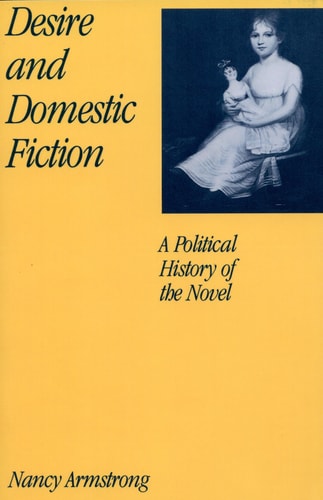
Desire and Domestic Fiction
0
0
As an Amazon Associate and affiliate partner, Menrva Books earns from qualifying purchases. Learn more
Author Description
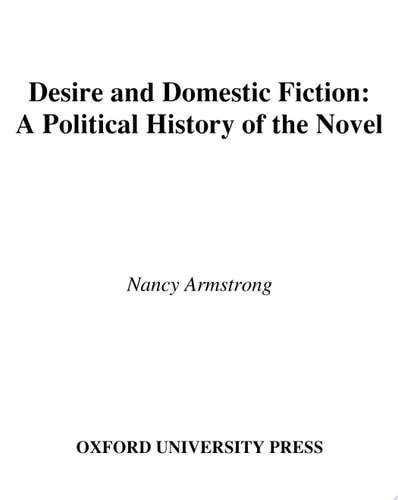
Desire And Domestic Fiction Argues That Far From Being Removed From Historical Events, Novels By Writers From Richardson To Woolf Were Themselves Agents Of The Rise Of The Middle Class. Drawing On Texts That Range From 18th-century Female Conduct Books And Contract Theory To Modern Psychoanalytic Case Histories And Theories Of Reading, Armstrong Shows That The Emergence Of A Particular Form Of Female Subjectivity Capable Of Reigning Over The Household Paved The Way For The Establishment Of Institutions Which Today Are Accepted Centers Of Political Power. Neither Passive Subjects Nor Embattled Rebels, The Middle-class Women Who Were Authors And Subjects Of The Major Tradition Of British Fiction Were Among The Forgers Of A New Form Of Power That Worked In, And Through, Their Writing To Replace Prevailing Notions Of Identity With A Gender-determined Subjectivity. Examining The Works Of Such Novelists As Samuel Richardson, Jane Austen, And The Brontës, She Reveals The Ways In Which These Authors Rewrite The Domestic Practices And Sexual Relations Of The Past To Create The Historical Context Through Which Modern Institutional Power Would Seem Not Only Natural But Also Humane, And Therefore To Be Desired.
Menrva's Summary
THE THESIS
This work investigates how the development of the domestic novel in Britain functioned as a primary mechanism for constructing middle-class identity and institutional power. Nancy Armstrong, a scholar of literature and cultural theory, utilizes a cross-disciplinary approach to analyze the intersection of 18th-century conduct literature, political theory, and the canonical British novel. She argues that the domestic sphere was not a retreat from history but a site where a new form of gendered subjectivity was forged, ultimately legitimizing modern political and social institutions.
THE SCOPE MAP
What You Will Find
- Analysis of 18th-century female conduct books and contract theory.
- Examination of canonical works by authors including Samuel Richardson, Jane Austen, and the Brontës.
- Integration of modern psychoanalytic case histories and theories of reading.
- A historical framework linking domestic practices to the rise of middle-class political power.
THE AUTHORITY PERSPECTIVE
Scholars frequently cite this text as a foundational contribution to the study of the novel as a political instrument. Readers often note the high level of academic density and the rigorous theoretical framework applied to literary history.
Page Count:
322
Publication Date:
1987-01-01
Publisher:
Oxford University Press
ISBN-10:
0195364740
ISBN-13:
9780195364743
History
Sociology
Gender Studies
British literature
Literary Criticism
Community Tags
Similar Books