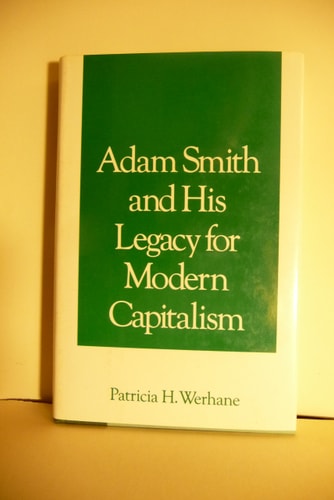
Adam Smith and His Legacy for Modern Capitalism
0
0
As an Amazon Associate and affiliate partner, Menrva Books earns from qualifying purchases. Learn more
Author Description
This book reexamines Adam Smith's major works from a philosophical point of view. Werhane shows how Smith's three major works, The Theory of Moral Sentiments, Lectures on Jurisprudence, and The Wealth of Nations present a progressive and unified set of theses. This careful study attacks the caricature of Adam Smith as a radical individualist who argued that government should play no role in economic affairs, and that the market is autonomous and self-regulating. Werhane shows that Smith argues that human beings are not motivated merely by self-interest in economic affairs nor is the market an autonomous regulator. An economy functions adequately only when free economic actors act with prudence, when there is cooperation and coordination of competitive activities, and where competition is balanced in the context of a societal framework of justice. Werhane argues that a careful reading of Smith's major works show that it is justice, not self-interest or benevolence, that is the most basic virtue to Smith, and that a system of natural jurisprudence is necessary for a viable as well as an ideal political economy.
Menrva's Summary
THE THESIS
This book investigates the philosophical foundations of Adam Smith's economic theories to challenge the prevailing caricature of him as a proponent of radical individualism and unregulated markets. Patricia H. Werhane, a scholar of business ethics and philosophy, analyzes Smith's primary texts—The Theory of Moral Sentiments, Lectures on Jurisprudence, and The Wealth of Nations—to demonstrate that they form a cohesive, unified argument. She posits that Smith viewed justice, rather than pure self-interest, as the fundamental virtue required for a functioning political economy. By contextualizing Smith's work within a framework of natural jurisprudence, Werhane argues that his vision for capitalism necessitates social cooperation and institutional oversight.
THE SCOPE MAP
What You Will Find
- A philosophical re-examination of Smith's three major treatises.
- An analysis of the role of justice as the primary virtue in Smith's economic system.
- A critique of the 'radical individualist' interpretation of Smith's market theories.
- A framework for understanding how prudence and competition interact within a societal structure.
THE AUTHORITY PERSPECTIVE
Scholars and students of economic history frequently cite this work as a necessary corrective to common misconceptions regarding Smith's political philosophy. Experts highlight the text as a foundational resource for those seeking to understand the ethical dimensions of classical economic theory.
Page Count:
240
Publication Date:
1991-08-22
Publisher:
Oxford University Press
ISBN-10:
0195068289
ISBN-13:
9780195068283
Philosophy
History
Economics
Economics history
Capitalism
Community Tags
Similar Books