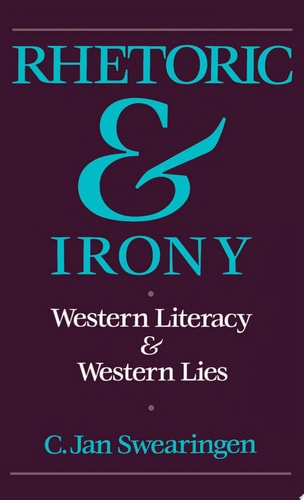
Rhetoric and Irony: Western Literacy and Western Lies
0
0
As an Amazon Associate and affiliate partner, Menrva Books earns from qualifying purchases. Learn more
Author Description
This pathbreaking study integrates the histories of rhetoric, literacy, and literary aesthetics up to the time of Augustine, focusing on Western concepts of rhetoric as dissembling and of language as deceptive that Swearingen argues have received curiously prominent emphasis in Western aesthetics and language theory. Swearingen reverses the traditional focus on rhetoric as an oral agonistic genre and examines it instead as a paradigm for literate discourse. She proposes that rhetoric and literacy have in the West disseminated the interrelated notions that through learning rhetoric individuals can learn to manipulate language and others; that language is an unreliable, manipulable, and contingent vehicle of thought, meaning, and communication; and that literature is a body of pretty lies and beguiling fictions. In a bold concluding chapter Swearingen aligns her thesis concerning early Western literacy and rhetoric with contemporary critical and rhetorical theory; with feminist studies in language, psychology, and culture; and with studies of literacy in multi- and cross-cultural settings.
Menrva's Summary
THE THESIS
This study investigates the historical development of Western rhetoric and literacy to determine how these disciplines established the enduring perception of language as a deceptive and manipulative tool. C. Jan Swearingen, a scholar of classical rhetoric and literary theory, synthesizes historical data from antiquity through the time of Augustine to challenge traditional interpretations of oral discourse. She argues that the Western tradition has consistently framed rhetoric not merely as a method of persuasion, but as a paradigm for literate discourse that inherently promotes the manipulation of meaning and the categorization of literature as a collection of artful falsehoods.
THE SCOPE MAP
What You Will Find
- Historical analysis of rhetoric and literacy from classical antiquity to the era of Augustine.
- A re-evaluation of rhetoric as a paradigm for literate discourse rather than an oral agonistic genre.
- Examination of the intersection between early rhetorical theory and contemporary critical studies.
- Integration of feminist perspectives and cross-cultural literacy studies to contextualize Western language theory.
THE AUTHORITY PERSPECTIVE
Scholars and critics recognize this work as a significant contribution to the history of rhetoric and the deconstruction of Western linguistic traditions. Readers frequently note the academic density of the prose, which serves as a foundational text for those examining the philosophical underpinnings of literary aesthetics.
Page Count:
344
Publication Date:
1991-09-05
Publisher:
Oxford University Press
ISBN-10:
0195063627
ISBN-13:
9780195063622
Philosophy
History
Literary Criticism
Dialectic
Rhetoric
Language Theory
Irony
Community Tags
Similar Books