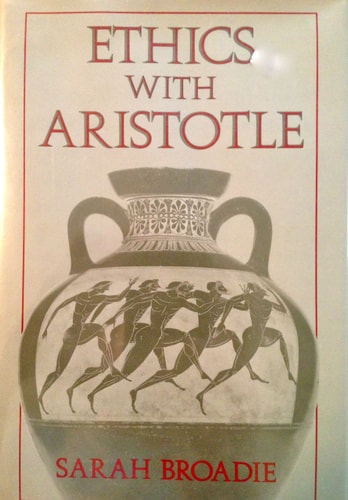
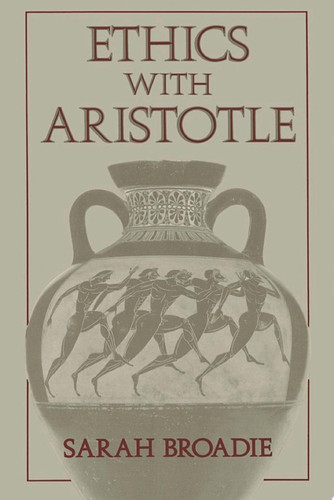
Ethics With Aristotle
0
0
As an Amazon Associate and affiliate partner, Menrva Books earns from qualifying purchases. Learn more
Author Description
In this incisive study Sarah Broadie gives an argued account of the main topics of Aristotle's ethics: eudaimonia, virtue, voluntary agency, practical reason, akrasia, pleasure, and the ethical status of theoria. She explores the sense of "eudaimonia," probes Aristotle's division of the soul and its virtues, and traces the ambiguities in "voluntary." Fresh light is shed on his comparison of practical wisdom with other kinds of knowledge, and a realistic account is developed of Aristototelian deliberation. The concept of pleasure as value-judgment is expounded, and the problem of akrasia is argued to be less of a problem to Aristotle than to his modern interpreters. Showing that the theoretic ideal of Nicomachean Ethics X is in step with the earlier emphasis on practice, as well as with the doctrine of the Eudemian Ethics, this work makes a major contribution towards the understanding of Aristotle's ethics.
Menrva's Summary
THE THESIS
This study investigates the core components of Aristotelian ethics to determine how his concepts of virtue, reason, and happiness form a coherent philosophical framework. Sarah Broadie, a scholar of ancient philosophy, utilizes a rigorous analytical approach to examine the Nicomachean Ethics and the Eudemian Ethics. She argues that Aristotle's ethical system is more internally consistent than many modern interpretations suggest, particularly regarding the relationship between practical action and theoretical contemplation.
THE SCOPE MAP
What You Will Find
- Analysis of key Aristotelian concepts including eudaimonia, akrasia, and theoria
- Examination of the soul's division and the nature of voluntary agency
- Comparative study of practical wisdom versus other forms of knowledge
- Synthesis of the Nicomachean and Eudemian ethical doctrines
THE AUTHORITY PERSPECTIVE
Scholars and students of philosophy frequently cite this work as a rigorous and essential text for understanding the complexities of Aristotle's moral theory. Readers often note the academic density of the prose, which is intended for those already familiar with the primary source material.
Page Count:
480
Publication Date:
1991-01-10
Publisher:
Oxford University Press
ISBN-10:
0195066014
ISBN-13:
9780195066012
Non-Fiction
Philosophy
Politics
Ethics
Categories
Ethics & Morality
Kindle eBooks
Greek & Roman
Aristotle
Kindle Store
Community Tags
Other Editions(3)
Similar Books