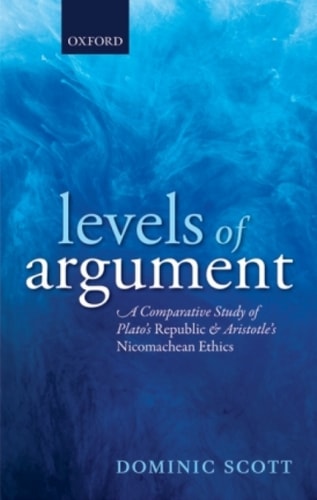
Levels of Argument: A Comparative Study of Plato's Republic and Aristotle's Nicomachean Ethics
0
0
As an Amazon Associate and affiliate partner, Menrva Books earns from qualifying purchases. Learn more
Author Description
In Levels of Argument, Dominic Scott compares the Republic and Nicomachean Ethics from a methodological perspective. In the first half he argues that the Republic distinguishes between two levels of argument in the defence of justice, the 'longer' and 'shorter' routes. The longer is the ideal and aims at maximum precision, requiring knowledge of the Forms and a definition of the Good. The shorter route is less precise, employing hypotheses, analogies and empirical observation. This is the route that Socrates actually follows in the Republic, because it is appropriate to the level of his audience and can stand on its own feet as a plausible defence of justice. In the second half of the book, Scott turns to the Nicomachean Ethics. Scott argues that, even though Aristotle rejects a universal Form of the Good, he implicitly recognises the existence of longer and shorter routes, analogous to those distinguished in the Republic. The longer route would require a comprehensive theoretical worldview, incorporating elements from Aristotle's metaphysics, physics, psychology, and biology. But Aristotle steers his audience away from such an approach as being a distraction from the essentially practical goals of political science. Unnecessary for good decision-making, it is not even an ideal. In sum, Platonic and Aristotelian methodologies both converge and diverge. Both distinguish analogously similar levels of argument, and it is the shorter route that both philosophers actually follow--Plato because he thinks it will have to suffice, Aristotle because he thinks that there is no need to go beyond it.
Menrva's Summary
THE THESIS
This book investigates the methodological parallels and distinctions between Plato’s Republic and Aristotle’s Nicomachean Ethics regarding how each philosopher constructs their arguments for justice and ethics. Dominic Scott, a scholar of ancient philosophy, utilizes a comparative framework to analyze how both thinkers employ varying levels of argumentative precision. He argues that both philosophers prioritize practical, accessible arguments over theoretical ideals, despite their differing metaphysical foundations.
THE SCOPE MAP
What You Will Find
- A comparative analysis of the 'longer' and 'shorter' routes of argumentation in Plato's Republic.
- An examination of Aristotelian methodology regarding the Good and practical decision-making.
- A synthesis of how metaphysical, physical, and psychological theories inform ethical discourse.
Scope Limits
- The text does not provide a general introduction to either philosopher's complete body of work.
- It focuses specifically on the methodological structure of argument rather than a comprehensive commentary on every book of the Republic or the Nicomachean Ethics.
THE AUTHORITY PERSPECTIVE
Scholars and students of classical philosophy frequently cite this work for its clear articulation of the structural similarities between Platonic and Aristotelian argumentation. The text is noted for its academic rigor and is considered a valuable resource for those examining the intersection of ancient ethics and political theory.
Page Count:
240
Publication Date:
2015-01-01
Publisher:
OUP Oxford
ISBN-10:
0191055883
ISBN-13:
9780191055881
Philosophy
Academic
Aristotle
Plato
History & Surveys
Political Philosophy
Ethics
Community Tags
Similar Books