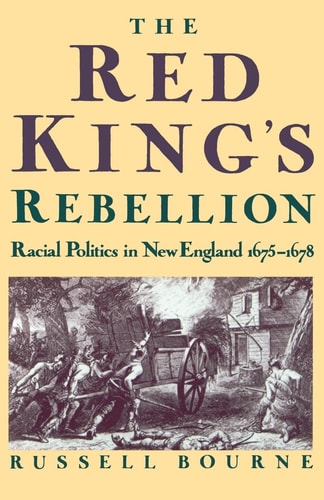
The Red King's Rebellion: Racial Politics in New England 1675-1678
0
0
As an Amazon Associate and affiliate partner, Menrva Books earns from qualifying purchases. Learn more
Author Description
"The Red King's Rebellion," fought more than three hundred years ago between the Algonquian peoples and New England settlers, was in per-capita terms the bloodiest war in our nation's history. Before the conflict ended, over 9,000 people were dead (two-thirds of them Native Americans), and homelessness, starvation, and economic hardship plagued the descendents of both races for generations to come. In this fascinating book, Russell Bourne examines the epic struggle from both sides, seeking to explain how the biracial harmony that once reigned--when the Plymouth Colony's neighboring Wampanoags, under the stately Massasoit (King Philip's father), shared their corn with desperate settlers--could degenerate into such mistrust and hatred. More than just a war, Bourne shows how it was a simultaneous rebellion on many fronts against inequalities practiced by white settlers, and demonstrates how it constituted a massive and tragic breakdown of colonial civilization.Distrusting the accounts of early nationalists as propaganda, and drawing on the recent work of archaeologists, the expertise of local historical societies, and his own considerable knowledge of the New England countryside, Bourne brings this turbulent era to life. We are led along the old Indian trails that once criss-crossed New England, we visit the settlements of colonists and Native Americans alike, and we meet a fascinating cast of characters. These include the intrepid settler Benjamin Church (who first sought to dissuade colonial leaders from slaughter, then taught them how to fight woodland battles), the radical preacher and trader Roger Williams (who had learned the native language and tried for decades to keep the cultures together), and Metacomet himself--soon to be known as King Philip--whom we glimpse striding proudly through pre-war Boston wearing "buckskins set thick with these beads [of wampum] in pleasant wild works and a broad belt of the same."
Menrva's Summary
THE THESIS
How did the initial period of cooperation between New England settlers and the Wampanoag people collapse into the deadliest conflict in American history? Russell Bourne utilizes a synthesis of archaeological findings, local historical records, and primary source analysis to re-examine King Philip's War. He argues that the conflict was not merely a military engagement but a systemic failure of colonial relations driven by deep-seated inequalities and mutual mistrust.
THE SCOPE MAP
What You Will Find
- A detailed examination of the period between 1675 and 1678 in New England.
- Analysis of the socio-political dynamics between Algonquian peoples and English colonists.
- Biographical sketches of key figures including Metacomet, Benjamin Church, and Roger Williams.
- An exploration of the geographical landscape and the strategic use of Indian trails in woodland warfare.
THE AUTHORITY PERSPECTIVE
Historians and readers appreciate this work for its balanced perspective that avoids the biases of early nationalist propaganda. The text is frequently cited for its accessible narrative style, which effectively bridges the gap between academic research and general historical interest.
Page Count:
304
Publication Date:
1991-05-23
Publisher:
Oxford University Press
ISBN-10:
0195069765
ISBN-13:
9780195069761
History
Government relations
Military History
East Indians
Colonial History
Community Tags
Similar Books