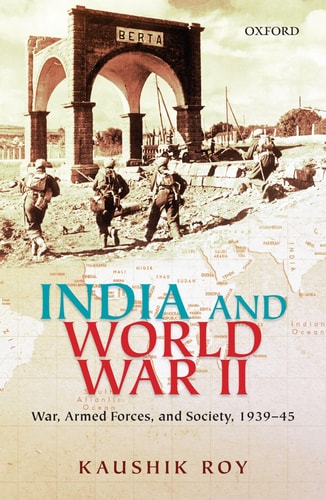
India and World War II: War, Armed Forces, and Society, 1939-45
0
0
As an Amazon Associate and affiliate partner, Menrva Books earns from qualifying purchases. Learn more
Author Description
The Second World War remains a defining chapter in modern world history. Colonial India's involvement in the war has often been studied against the backdrop of the ongoing freedom struggle, the varying attitudes of the Indian National Congress and the Muslim League, and the formation of the Azad Hind Fauj under Subhas Chandra Bose. Moving beyond the claims of how Indian resources and soldiers aided the Allies in winning the war, this volume explores the complex interrelationship between the Indian armed forces, the Indian society, and the war.Drawing on archival data, this book focuses on understanding the impact of large-scale mobilization of manpower and resources on an underdeveloped agrarian society; the communities which joined the Indian armed forces; why the Indian soldiers remained loyal to the Raj; and how they defeated the Japanese in Burma and the Italians and the Germans in Africa and Italy.Rather than merely providing a chronological account of military operations, Roy fuses ideas and institutions of violence with the prevalent social and cultural contexts. He further asserts that nationalism was not a strong sentiment among the Indian soldiers involved in the war, who were quite content with the British military service.
Menrva's Summary
THE THESIS
This volume investigates the complex, multifaceted relationship between the Indian armed forces, colonial society, and the global conflict of the Second World War. Author Kaushik Roy, a specialist in military history, utilizes extensive archival data to challenge traditional narratives that focus solely on the Indian freedom struggle. He argues that the massive mobilization of manpower and resources fundamentally altered the structure of an underdeveloped agrarian society while examining the motivations behind the continued loyalty of Indian soldiers to the British Raj.
THE SCOPE MAP
What You Will Find
- Analysis of the socio-economic impact of large-scale military mobilization on agrarian communities.
- Examination of the recruitment patterns and demographic composition of the Indian armed forces.
- Evaluation of military performance against Japanese, Italian, and German forces in diverse theaters of war.
- Critical assessment of the role of nationalism versus institutional loyalty among colonial soldiers.
THE AUTHORITY PERSPECTIVE
Scholars and historians recognize this work as a significant contribution to the study of colonial military history, noting its departure from purely political or nationalist-centered accounts. Readers frequently highlight the author's ability to synthesize institutional military history with broader social and cultural contexts.
Page Count:
432
Publication Date:
2016-10-01
Publisher:
Oxford University Press
ISBN-10:
0199463530
ISBN-13:
9780199463534
History
Colonial History
Military History
India
Community Tags
Similar Books