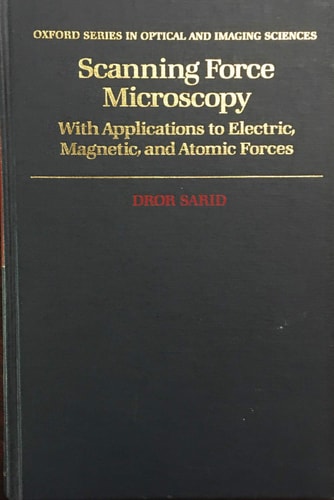
Scanning Force Microscopy: With Applications to Electric, Magnetic, and Atomic Forces
0
0
As an Amazon Associate and affiliate partner, Menrva Books earns from qualifying purchases. Learn more
Author Description
Scanning tunneling microscopy (STM), invented by Binnig and Rohrer in 1982, enables one to obtain images reflecting surface electronic structure with atomic resolution. As an offshoot of this technology, Binnig, Quate and Gerber in 1986 invented atomic force microscopy (AFM), also capable of achieving atomic resolution. By now this technology proved to be an indispensable characterization tool with applications to surface physics and chemistry, material science, bio-science and data storage media, with promise in such areas as the semiconductor industry and optical quality control, for example. This book is the first attempt at organizing the whole rainbow of rapidly developing topics dealing with the mapping of a variety of forces across surfaces. Academic and industrial researchers using STM, or wishing to know more about its potential, will find this book a valuable source of up-to-date information.
Menrva's Summary
THE THESIS
This text investigates the technical principles and diverse applications of scanning force microscopy as a method for mapping surface forces at the atomic level. Dror Sarid provides a comprehensive framework for understanding the transition from scanning tunneling microscopy to atomic force microscopy. The book synthesizes theoretical models of force interactions with practical implementation strategies for researchers in physics, chemistry, and material science.
THE SCOPE MAP
What You Will Find
- Theoretical foundations of scanning tunneling and atomic force microscopy
- Mathematical models for electric, magnetic, and atomic force interactions
- Analysis of surface electronic structure and imaging techniques
- Applications in semiconductor manufacturing and data storage media
THE AUTHORITY PERSPECTIVE
Experts recognize this work as a foundational text for understanding the early development and technical versatility of scanning force microscopy. Readers frequently note the academic density of the prose, which serves as a technical resource for researchers and industrial scientists.
Page Count:
272
Publication Date:
1991-04-04
Publisher:
Oxford University Press
ISBN-10:
0195062701
ISBN-13:
9780195062700
Science
Physics
Technology
Microscopy
Community Tags
Similar Books