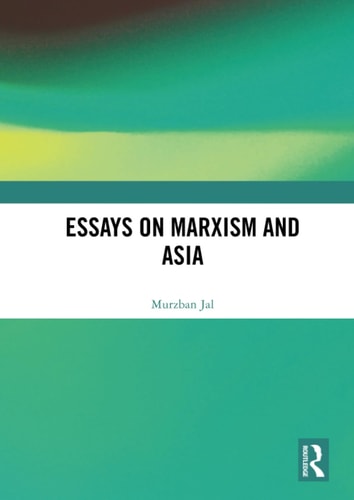
Essays on Marxism and Asia
0
0
As an Amazon Associate and affiliate partner, Menrva Books earns from qualifying purchases. Learn more
Author Description
Essays on Marxism and Asia begins with the largely forgotten prophet of ancient Iran Zarathushtra, remembered and immortalised by Friedrich Nietzsche's Also Sprach Zarathustra. In contrast to the infamous clash of civilisation thesis, this book argues for a humanist theory of civilisations and studies the Parsis or Persians who left Iran to settle in India and make it their home. It claims that Parsis, despite being a migrant community, took strength from their Persian heritage and civilisation and rose to become the architects of industrial modernity in India. This book locates this humanist theory in the larger genre of the Asiatic mode of production with caste as its sub- text. It then takes a phenomenological reading of caste in India and says that India is afflicted by a very strange illness called 'silent blindness' where humanity is silenced and blinded in front of the caste apparatus. It then analyzes how capitalism and modernity fashioned caste in the image of capitalism and how the Indian right- wing imagined its fascistic politics of race and racial superiority based on the image of caste hierarchy. The problem in India has been that the liberals could not take caste seriously so as to confront it and then annihilate this violent apartheid structure. This, the book argues, has led to the rise of fascism in India. The book concludes with positing two different strands of secularism, namely liberal or bourgeois secularism which merely separates religion and the state (but mixes these when required) and revolutionary secularism which humanises religion and politics first in order to find the human and class content in both. The chapters in this book were originally published in Critique: Journal of Socialist Theory.
Menrva's Summary
THE THESIS
This book investigates the complex interplay between Marxist theory, Asian civilizations, and the enduring impact of caste in India, particularly in the context of modernity and capitalism. Authored by Murzban Jal, a scholar whose work often engages with critical theory and social analysis, this collection of essays draws upon historical texts, philosophical concepts, and sociological observations. The book posits a humanist theory of civilizations as an alternative to the clash of civilizations thesis, using the Parsi community in India as a case study for their role in industrial modernity. It then critically examines the caste system in India, framing it as a profound societal illness that has been exacerbated and reshaped by capitalism and modernity, ultimately contributing to the rise of fascism.
THE SCOPE MAP
- An exploration of Zarathushtra and his influence on Nietzsche, serving as a philosophical precursor.
- A humanist theory of civilizations contrasted with the 'clash of civilizations' thesis.
- The historical role of the Parsi community in India's industrial modernization.
- An analysis of the Asiatic mode of production with caste as a central sub-text.
- A phenomenological reading of caste in India, termed 'silent blindness'.
- An examination of how capitalism and modernity have shaped caste structures.
- An analysis of the Indian right-wing's fascist politics rooted in caste hierarchy.
- A discussion on the failure of liberals to address and dismantle the caste system.
- A distinction between liberal/bourgeois secularism and revolutionary secularism.
THE AUTHORITY PERSPECTIVE
The essays in this book were originally published in 'Critique: Journal of Socialist Theory,' suggesting a readership interested in critical socialist perspectives and academic discourse. The book's approach, which links ancient philosophy to contemporary Indian social and political issues, indicates a dense, analytical text. It appears to offer a challenging perspective on secularism, caste, and the rise of fascism in India, likely appealing to scholars and activists engaged with these specific topics.
Page Count:
170
Publication Date:
2022-01-01
Publisher:
Routledge
ISBN-10:
0367618796
ISBN-13:
9780367618797
History
Philosophy
Non-Fiction
Politics
Sociology
Community Tags
Other Editions(3)

Similar Books













Reader Comments
Share Your Thoughts
No comments yet. Be the first to share your thoughts!