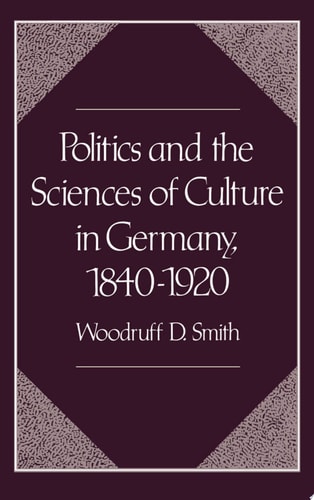
Politics and the Sciences of Culture in Germany, 1840-1920
0
0
As an Amazon Associate and affiliate partner, Menrva Books earns from qualifying purchases. Learn more
Author Description
Examining the ways in which politics and ideology stimulate and shape changes in human science, this book focuses on the cultural sciences in nineteenth and early twentieth-century Germany. The book argues that many of the most important theoretical directions in German cultural science had their origins in a process by which a general pattern of social scientific thinking, one that was closely connected to political liberalism and dominant in Germany (and elsewhere) before the mid-nineteenth century, fragmented in the face of the political troubles of German liberalism after that time. Some liberal social scientists who wanted to repair both liberalism and the liberal theoretical pattern, and others who wanted to replace them with something more conservative, turned to the concept of culture as the focus of their intellectual endeavors. Later generations of intellectuals repeated the process, motivated in large part by the experiences of liberalism as a political movement in the German Empire. Within this framework, the book discusses the formation of diffusionism in German anthropology, Friedrich Ratzel's theory of Lebensraum, folk psychology, historical economics, and cultural history. It also relates these developments to German imperialism, the rise of radical nationalism, and the upheaval in German social science at the turn of the century.
Menrva's Summary
THE THESIS
This book investigates how the political decline of German liberalism between 1840 and 1920 catalyzed the fragmentation and subsequent evolution of social scientific thought into the distinct field of cultural science. Woodruff D. Smith, a historian specializing in modern European intellectual history, utilizes archival research and primary source analysis to demonstrate how political instability forced intellectuals to pivot toward the concept of 'culture' as a framework for both conservative and liberal agendas. By tracing the trajectory of these ideas, the author argues that the development of German social science was inextricably linked to the shifting political fortunes of the German Empire and the rise of radical nationalism.
THE SCOPE MAP
What You Will Find
- Analysis of the transition from general social scientific patterns to specialized cultural sciences.
- Examination of key intellectual developments including diffusionism in anthropology and Friedrich Ratzel's theory of Lebensraum.
- Investigation into the intersection of folk psychology, historical economics, and cultural history.
- Discussion of the influence of German imperialism and political liberalism on academic theory.
THE AUTHORITY PERSPECTIVE
Scholars recognize this work as a rigorous examination of the nexus between political ideology and academic institutionalization in nineteenth-century Germany. Experts frequently cite the text for its detailed mapping of how political crises directly informed the theoretical shifts within the German social sciences.
Page Count:
320
Publication Date:
1991-06-20
Publisher:
Oxford University Press
ISBN-10:
0195065360
ISBN-13:
9780195065367
Philosophy
History
Intellectual History
Germany
Learning and scholarship
Sociology
Community Tags
Other Editions(2)

Similar Books