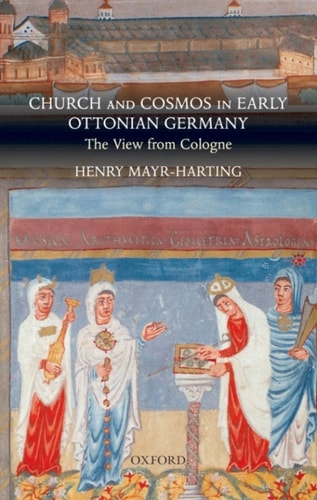
Church and Cosmos in Early Ottonian Germany: The View from Cologne
0
0
As an Amazon Associate and affiliate partner, Menrva Books earns from qualifying purchases. Learn more
Author Description
Integrating the brilliant biography of Bruno, Archbishop of Cologne (953-65) and brother of Emperor Otto I, by the otherwise obscure monk Ruotger, with the intellectual culture of Cologne Cathedral, this is a study of actual politics in conjunction with Ottonian ruler ethic. Our knowledge of Cologne intellectual activity in the period, apart from Ruotger, must be pieced together mainly from marginal annotations and glosses in surviving Cologne manuscripts, showing how and with what concerns some of the most important books of the Latin West were read in Bruno's and Ruotger's Cologne. These include Pope Gregory the Great's Letters, Prudentius's Psychomachia, Boethius's Arithmetic, and Martianus Capella's Marriage of Philology and Mercury. The writing in the margins of the manuscripts, besides enlarging our picture of thinking in Cologne in itself, can be drawn into comparison with the outlook of Ruotger. Exploring how distinctive Cologne was, compared with other centres, Henry Mayr-Harting brings out an unexpectedly strong thread of Platonism in the tenth-century intellect. The book includes a critical edition of probably the earliest surviving, and hitherto unpublished, set of glosses to Boethius's Arithmetic, with an extensive study of their content.
Menrva's Summary
THE THESIS
How did the intellectual culture of tenth-century Cologne, as reflected in the writings of the monk Ruotger and local manuscript annotations, shape the political and religious ethics of the Ottonian era? Henry Mayr-Harting, a distinguished historian of the medieval Church, utilizes a combination of biographical analysis and paleographic evidence to argue that Cologne served as a unique center of Platonic thought that informed the governance of Emperor Otto I and his circle. By examining the marginalia of foundational Latin texts, the author reconstructs the mental framework of the Ottonian elite.
THE SCOPE MAP
What You Will Find
- Analysis of the biography of Bruno, Archbishop of Cologne, written by the monk Ruotger.
- Examination of marginal annotations in manuscripts of Gregory the Great, Prudentius, Boethius, and Martianus Capella.
- A critical edition and study of previously unpublished glosses to Boethius's Arithmetic.
- Comparative analysis of Cologne's intellectual climate against other contemporary European centers.
Scope Limits
- The study is geographically restricted to the intellectual output of Cologne Cathedral.
- The research focuses primarily on the tenth-century period, specifically the years 953–965.
THE AUTHORITY PERSPECTIVE
Scholars recognize this work as a significant contribution to the study of Ottonian intellectual life, particularly for its innovative use of marginalia to reconstruct medieval thought. Experts frequently note the academic density of the prose and the specialized nature of the manuscript analysis, making it a primary resource for historians of medieval education and political theology.
Page Count:
260
Publication Date:
2007-01-01
Publisher:
OUP Oxford
ISBN-10:
0191526223
ISBN-13:
9780191526220
History
European History
Intellectual History
Germany
Church History
Community Tags
Similar Books