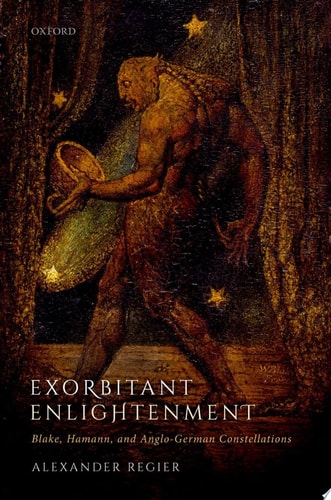
Exorbitant Enlightenment: Blake, Hamann, and Anglo-German Constellations
0
0
As an Amazon Associate and affiliate partner, Menrva Books earns from qualifying purchases. Learn more
Author Description
Exorbitant Enlightenment compels us to see eighteenth- and early nineteenth-century literature and culture in new ways. This book reveals a constellation of groundbreaking pre-1790s Anglo-German relations, many of which are so radical âso exorbitantâ that they ask us to fundamentally rethink the ways we grasp literary and intellectual history, especially when it comes to Enlightenment and Romanticism.Regier presents two of the great, untold stories of the eighteenth century. The first story uncovers a forgotten Anglo-German network of thought and writing in Britain between 1700 and 1790. From this Anglo-German context emerges the second story: about a group of idiosyncratic figures and institutions, including the Moravians in 1750s London, Henry Fuseli, and Johann Caspar Lavater, as well as the two most exorbitant figures, William Blake and Johann Georg Hamann. The bookâs eight chapters show how these authors and institutions shake up common understandings of British literary and European intellectual history and offer a very different, much more counter-intuitive view of the period. Through their distinctive conceptions of language, Blake and Hamann articulate âin different yet deeply related waysâ a radical critique of instrumental thought and institutional religion. They also argue for the irreducible relation between language and the sexual body. In each case, they push against some of the most central cultural and philosophical assumptions, then and now. The book argues that, when taken seriously, these exorbitant figures allow us to uncover and revise some of our own critical orthodoxies.
Menrva's Summary
THE THESIS
This book investigates the radical, often overlooked Anglo-German intellectual networks of the eighteenth century to challenge established narratives of the Enlightenment and Romanticism. Alexander Regier, a scholar of eighteenth-century literature, utilizes archival research and comparative analysis to map the connections between British and German thinkers. He argues that figures like William Blake and Johann Georg Hamann represent an 'exorbitant' tradition that critiques instrumental reason and institutional religion while emphasizing the intersection of language and the physical body. By re-examining these fringe intellectual movements, the author provides a framework for revising contemporary critical orthodoxies regarding the period.
THE SCOPE MAP
What You Will Find
- A detailed analysis of Anglo-German cultural and intellectual exchange between 1700 and 1790.
- Examination of the influence of the Moravian community in London on literary and philosophical development.
- Comparative studies of idiosyncratic figures including Henry Fuseli, Johann Caspar Lavater, William Blake, and Johann Georg Hamann.
- A critical methodology for identifying and interpreting counter-intuitive historical narratives that challenge standard periodization.
THE AUTHORITY PERSPECTIVE
Scholars and critics recognize this work as a significant contribution to the study of transatlantic and cross-cultural intellectual history. Readers frequently note the academic density of the prose, which is intended for specialists in eighteenth-century studies and philosophy.
Page Count:
272
Publication Date:
2019-02-06
Publisher:
Oxford University Press
ISBN-10:
0198827121
ISBN-13:
9780198827122
History
Philosophy
Great Britain
Enlightenment
English & College Success
Literary Criticism
Germany relations
Intellectual History
Germany
English
Romanticism
European History
Community Tags
Similar Books