Science of Coercion: Communication Research and Psychological Warfare, 1945-1960
0
0
As an Amazon Associate and affiliate partner, Menrva Books earns from qualifying purchases. Learn more
Author Description
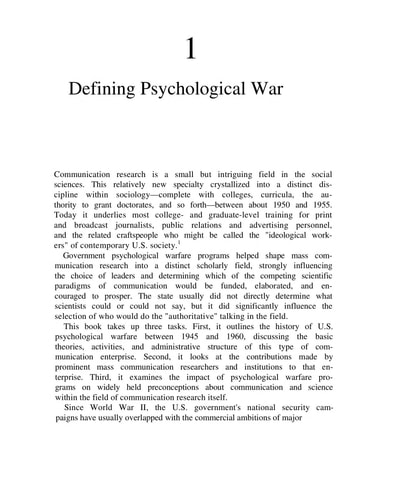
Science of Coercion provides the first thorough examination of the role of the CIA, the Pentagon, and other U.S. security agencies in the evolution of modern communication research, a field in the social sciences which crystallized into a distinct discipline in the early 1950s. Government-funded psychological warfare programs underwrote the academic triumph of preconceptions about communication that persist today in communication studies, advertising research, and in counterinsurgency operations.Christopher Simpson contends that it is unlikely that communication research could have emerged into its present form without regular transfusions of money from U.S military, intelligence, and propaganda agencies during the Cold War. These agencies saw mass communication as an instrument for persuading or dominating targeted groups in the United States and abroad; as a tool for improving military operations; and perhaps most fundamentally, as a means to extend the U.S. influence more widely than ever before at a relatively modest cost. Communication research, in turn, became for a time the preferred method for testing and developing such techniques. Science of Coercion uses long-classified documents to probe the contributions made by prominent mass communication researchers such as Wilbur Schramm, Ithiel de Sola Pool, and others, then details the impact of psychological warfare projects on widely held preconceptions about social science and the nature of communication itself.A fascinating case study in the history of science and the sociology of knowledge, Science of Coercion offers valuable insights into the dynamics of ideology and the social psychology of communication.
Menrva's Summary
THE THESIS
This book investigates the extent to which U.S. military and intelligence agencies shaped the development of modern communication research during the early Cold War period. Christopher Simpson, an investigative journalist and scholar, utilizes declassified government documents to argue that the academic discipline of communication studies was heavily influenced by funding from the CIA and the Pentagon. He posits that these agencies directed research toward psychological warfare and mass persuasion, thereby embedding specific ideological biases into the foundational theories of the social sciences.
THE SCOPE MAP
What You Will Find
- Historical analysis of communication research between 1945 and 1960.
- Examination of the influence of military and intelligence funding on academic institutions.
- Case studies involving prominent researchers such as Wilbur Schramm and Ithiel de Sola Pool.
- Investigation into the intersection of social science, propaganda, and counterinsurgency operations.
THE AUTHORITY PERSPECTIVE
Scholars and historians frequently cite this work as a critical examination of the institutional origins of communication theory. Readers often note the dense, evidence-heavy nature of the text, which provides a rigorous look at the sociology of knowledge during the Cold War era.
Page Count:
224
Publication Date:
1994-03-10
Publisher:
Oxford University Press
ISBN-10:
019507193X
ISBN-13:
9780195071931
History
Communication research
Communication Studies
United States
Cold War
Sociology
Community Tags
Similar Books