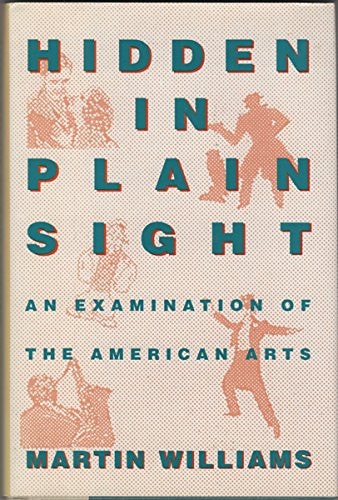
Hidden in Plain Sight: An Examination of the American Arts
0
0
As an Amazon Associate and affiliate partner, Menrva Books earns from qualifying purchases. Learn more
Author Description
When Mikhail Baryshnikov defected to the United States in 1974, he announced that his hero as a dancer was Fred Astaire. Many Americans were surprised that a highly popular figure from the movies could inspire a classically trained European dancer, just as they would be surprised to hear Duke Ellington called a great composer in the same breath with Ravel. But these artists and others, writes Martin Williams, deserve such praise. Twentieth century America, he argues, has produced a rich and innovative culture whose best artists should be a source of national pride.In Hidden in Plain Sight, acclaimed critic Martin Williams offers an eloquent celebration of the achievements of American culture. Americans, Williams writes, have labored under the sense that the art forms created on our shores are less valid than the traditional art forms of Europe. In these lucid essays, he shows how certain American artists have achieved a range and power of their own. Specifically, rejecting such terms as "popular culture," Williams looks at such great, innovative artists as D.W. Griffith and Fred Astaire and shows how they virtually created their own genrers of art with a uniquely American outlook and temperament. He offers a brilliant look at Duke Ellington, exploring the range and enormous volume of his work and describing how he worked with his orchestra in the same way great dramatists (Shakespeare among them) have worked with the specific talents of their actors. Williams looks at comic strips and finds in E.C. Segar's original "Popeye" a perceptive and prophetic comic comment on dictatorship done in 1936. He sees Walt Kelly as a kind of American Father Goose. He discusses the aesthetics of TV by looking at "Bullwinkle and Rocky." He provides freshly revealing accounts of the detective story, the gangster thriller, and the radio satire of Fred Allen, and more. On the other hand, Williams seriously questions whether the United States has a folk music in the traditional sense.
Menrva's Summary
THE THESIS
Does American popular culture possess the same artistic validity and innovative depth as the traditional art forms of Europe? Martin Williams, a respected critic, argues that American artists have been unfairly marginalized by a cultural inferiority complex. Through a series of analytical essays, he demonstrates that figures like Duke Ellington, Fred Astaire, and D.W. Griffith created works of profound aesthetic significance that deserve recognition alongside classical masters.
THE SCOPE MAP
What You Will Find
- Analysis of American cultural icons including Duke Ellington, Fred Astaire, and D.W. Griffith.
- Examination of diverse media forms such as comic strips, television animation, and detective fiction.
- Critical evaluation of the distinction between popular culture and high art.
- Investigation into the existence and nature of American folk music traditions.
THE AUTHORITY PERSPECTIVE
Critics often cite this collection as a vital contribution to the study of American cultural history, noting its ability to elevate popular entertainment to the level of serious academic inquiry. Readers frequently highlight the clarity of Williams' prose and his success in challenging long-held biases regarding the hierarchy of artistic expression.
Page Count:
160
Publication Date:
1992-06-11
Publisher:
Oxford University Press
ISBN-10:
0195075005
ISBN-13:
9780195075007
Music
Mass media
Art History
Film Studies
American History
Essays
Community Tags
Similar Books