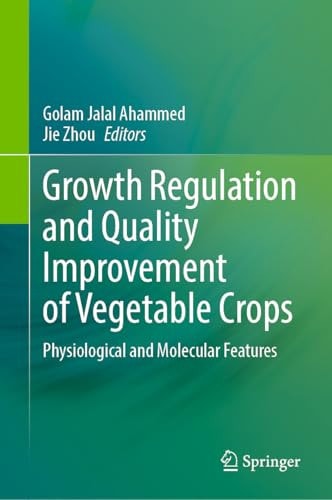
Growth Regulation and Quality Improvement of Vegetable Crops: Physiological and Molecular Features
0
0
As an Amazon Associate and affiliate partner, Menrva Books earns from qualifying purchases. Learn more
Author Description
This book compiles the latest advancements in vegetable crop growth, development, and quality improvement with potential implications for sustainable crop production. It covers aspects of light quality regulation, CO2 enrichment, beneficial microorganisms, epigenetic regulation, and perspectives on carbon-neutral protected vegetable production. Through this book, readers will gain new insights into the mechanisms of growth regulation, quality improvement, and stress tolerance in vegetable crops, encompassing the most recent biochemical, physiological, and molecular studies. The chapters cover topics such as seed germination processes, root trait regulation for defense mechanisms, essential nutrient management for optimal growth, stomatal function dynamics in vegetables, fruit development pathways, secondary metabolism roles in quality enhancement, abiotic stress response strategies, biotic stress resistance mechanisms, and post-harvest physiology in vegetable crops. The book provides a thorough examination of climate-smart technologies aimed at ensuring sustainable vegetable production amidst global climate change challenges. It addresses critical topics like food safety through detoxification of pesticide residues and explores innovative approaches such as hormonal regulation techniques, nanotechnology, the use of growth regulators, biostimulants, and grafting to enhance growth and stress tolerance in vegetables. This volume is an indispensable resource for professionals in olericulture, horticulture, and plant sciences. Researchers and advanced university students will find it particularly valuable for its comprehensive coverage of vegetable crop growth and quality improvement. The book's focus on sustainable agricultural practices makes it a must-read for anyone committed to addressing global food security challenges in the context of climate change.
Menrva's Summary
THE THESIS
This book investigates the intricate mechanisms governing vegetable crop growth and quality improvement, exploring their implications for sustainable agricultural practices. The authors delve into recent biochemical, physiological, and molecular studies, examining how factors like light quality, CO2 enrichment, beneficial microorganisms, and epigenetic regulation influence plant development. It addresses the challenges of climate change and food security by detailing climate-smart technologies and innovative approaches such as hormonal regulation, nanotechnology, and biostimulants. The volume aims to provide readers with new insights into enhancing stress tolerance and optimizing production in vegetable crops.
THE SCOPE MAP
- Latest advancements in vegetable crop growth and quality improvement.
- Mechanisms of light quality regulation and CO2 enrichment.
- Role of beneficial microorganisms and epigenetic regulation.
- Perspectives on carbon-neutral protected vegetable production.
- Biochemical, physiological, and molecular studies on vegetable crops.
- Climate-smart technologies for sustainable vegetable production.
- Innovative approaches including hormonal regulation, nanotechnology, and biostimulants.
THE AUTHORITY PERSPECTIVE
The book is positioned as an indispensable resource for professionals and advanced students in olericulture, horticulture, and plant sciences, offering comprehensive coverage of vegetable crop growth and quality improvement. Its focus on sustainable agricultural practices and addressing global food security challenges in the context of climate change suggests it will be of significant interest to researchers and practitioners in the field. The detailed examination of molecular and physiological features indicates a depth suitable for academic and research audiences.
Page Count:
690
Publication Date:
2025-04-16
Publisher:
Springer Nature Singapore
ISBN-10:
9819601681
ISBN-13:
9789819601684
Non-Fiction
Science
Plant Science
Agriculture
Horticulture
Physiology
Community Tags
Similar Books