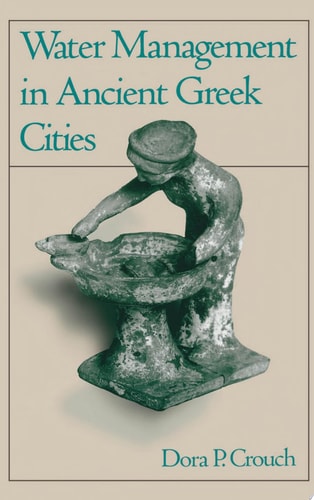
Water Management in Ancient Greek Cities
0
0
As an Amazon Associate and affiliate partner, Menrva Books earns from qualifying purchases. Learn more
Author Description
Focusing on the Mediterranean area where water management is crucial, this pioneering study is the first to show how the supply, distribution, and drainage of water contributed to the urbanization of ancient cities. Drawing from classical archaeology, the theory and history of urbanization, geology, and hydraulic engineering, Crouch examines water-system elements, including springs, fountains, wells, channels and drains, latrines, laundry, and dishwashing, as they relate to each other and to the physical, historical, and social bases of ancient Greek cities. Studying numerous sites including Pompeii, Pergamon, Athens, Samos, Delphi, and Corinth, she concludes that increased knowledge and skill in management of water contributed directly to the urbanization of the ancient Greek world. Illustrated with excellent photographs and line drawings, the discussions of supply, distribution, and drainage of water are organized topically, rather than chronologically or by site, offering an excellent example of the interdisciplinary approach. Crouch's study raises stimulating questions for further research, indicates entirely new directions for established academic disciplines, and suggests useful procedures for modern cities facing problems of water supply and management.
Menrva's Summary
THE THESIS
This study investigates how the sophisticated management of water supply, distribution, and drainage systems served as a primary catalyst for the development and urbanization of ancient Greek cities. Author Dora P. Crouch, an expert in classical archaeology and urban history, synthesizes data from geology, hydraulic engineering, and historical site analysis to construct a comprehensive framework. She argues that the evolution of water infrastructure was not merely a functional necessity but a foundational element that dictated the social and physical organization of the ancient Mediterranean world.
THE SCOPE MAP
What You Will Find
- Analysis of specific hydraulic elements including springs, fountains, wells, channels, drains, and latrines.
- Comparative study of major archaeological sites such as Athens, Corinth, Pergamon, Samos, and Pompeii.
- An interdisciplinary methodology integrating classical archaeology with modern urban planning theory.
- Topical examination of water management systems rather than a traditional chronological or site-specific narrative.
THE AUTHORITY PERSPECTIVE
Experts recognize this work as a foundational interdisciplinary text that bridges the gap between classical studies and civil engineering. Readers frequently note the academic density of the prose, which provides a rigorous examination of ancient infrastructure for both historians and urban planners.
Page Count:
400
Publication Date:
1993-06-24
Publisher:
Oxford University Press
ISBN-10:
0195072804
ISBN-13:
9780195072808
History
urban planning
Engineering
Archaeology
Cities And Towns
Water Supply
Ancient Greece
Community Tags
Other Editions(3)

Similar Books