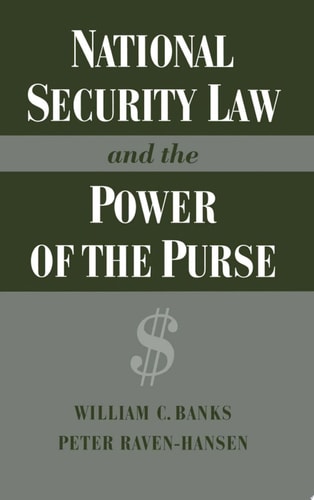
National Security Law and the Power of the Purse
0
0
As an Amazon Associate and affiliate partner, Menrva Books earns from qualifying purchases. Learn more
Author Description
The ideal model of national security decision-making, whereby the Legislative branch authorizes action to protect national security and the Executive branch takes it, has broken down due to the speed and unpredictability of foreign crises and the President's monopoly on foreign intelligence. In response, Congress has ceded the initiative to the President, and then utilized the power of the purse to ratify or restrict what the President has done. This power, by necessity and preference, has become the central congressional tool for participating in national security policy. Inevitably attacks on policy are transformed into attacks on the making and effects of appropriations. This study addresses the constitutional and statutory questions raised by these attacks. It thoroughly explores the history, mechanics, and scope of the power of the purse in national security, using Vietnam War appropriations and the Boland Amendments as case studies. William Banks and Peter Raven-Hansen provide a unique and provocative primer on the power of the purse in national security law.
Menrva's Summary
THE THESIS
This study investigates the constitutional and statutory implications of Congress utilizing the power of the purse as its primary mechanism for influencing national security policy in an era of executive dominance. Authors Peter Raven-Hansen and William C. Banks, both established legal scholars, analyze the shift in power dynamics between the Legislative and Executive branches. They argue that as the President has gained a monopoly on foreign intelligence and crisis response, Congress has increasingly relied on appropriations to ratify or restrict executive actions. The text provides a framework for understanding how policy debates are effectively transformed into fiscal battles within the federal government.
THE SCOPE MAP
What You Will Find
- Historical analysis of the evolution of congressional oversight in national security.
- Examination of the mechanics and legal scope of the power of the purse.
- Case studies focusing on Vietnam War appropriations and the Boland Amendments.
- Legal assessment of the constitutional questions surrounding executive and legislative authority.
THE AUTHORITY PERSPECTIVE
Legal scholars and political scientists identify this work as a foundational text for understanding the intersection of fiscal policy and national security law. Experts frequently note the clarity with which the authors navigate complex constitutional questions, making it a standard reference for those studying the limits of executive power.
Page Count:
272
Publication Date:
1994-07-21
Publisher:
Oxford University Press
ISBN-10:
0195085388
ISBN-13:
9780195085389
History
United States
National security
Constitutional Law
Law
Government
Community Tags
Similar Books