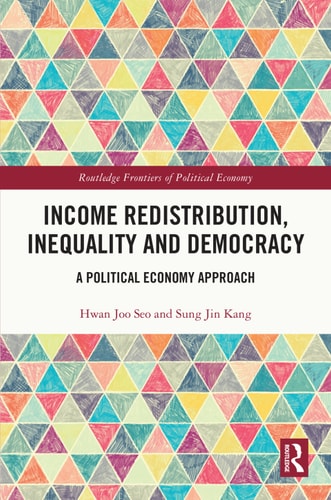
Income Redistribution, Inequality and Democracy
0
0
As an Amazon Associate and affiliate partner, Menrva Books earns from qualifying purchases. Learn more
Author Description
This book examines why democracy has failed to deliver effective solutions to income inequality problems over the last four decades, and if democracy can offer solutions to various increases in inequality in the future. It also addresses what elements are necessary for democracy to serve as an effective alternative for addressing inequality issues. Historical experiences over the past 40 years, including the global financial crisis, not only underscore the need for fresh perspectives on income inequality in economics but also question the ability of democracy to continue providing alternatives for addressing the escalating forms of inequality. Seo and Kang’s response to these inquiries diverge from conventional research in several significant ways. Primarily, what sets this research apart from existing studies is its intensified focus on income inequality as a product of the complex interplay between the political and economic domains, rather than a standalone examination of income inequality in isolation. Through a political economy perspective, this book argues that income inequality and income redistribution are shaped by the institutions, policies, and laws generated by the political system, with their formation and nature being determined by the power distribution among socio-political groups. A useful resource not only to researchers who study political phenomena in the field of economics, but also to scholars who study economic phenomena in the field of politics. Furthermore, it will be particularly intriguing for policy makers concerned with issues of inequality and income redistribution.
Menrva's Summary
THE THESIS
This book investigates the persistent failure of democratic systems to effectively address escalating income inequality over the past four decades. It explores whether democracy can provide future solutions to rising inequality and identifies the necessary elements for democracy to function as an effective mechanism for redistribution. The authors argue that income inequality is not solely an economic issue but is deeply intertwined with political institutions, policies, and the distribution of power among socio-political groups, shaping both inequality and redistribution efforts.
THE SCOPE MAP
- Analysis of historical experiences over the past 40 years, including the global financial crisis.
- Examination of the complex interplay between political and economic domains in shaping income inequality.
- A political economy perspective on how institutions, policies, and laws generated by the political system influence income redistribution.
- Discussion on the power distribution among socio-political groups as a determinant of inequality and redistribution.
- Exploration of the capacity of democracy to offer solutions to various increases in inequality.
- Identification of elements necessary for democracy to serve as an effective alternative for addressing inequality issues.
THE AUTHORITY PERSPECTIVE
The authors, Hwan Joo Seo and Sung Jin Kang, present a novel approach by focusing on the intricate relationship between political and economic factors in driving income inequality, diverging from studies that isolate economic phenomena. Their work is positioned as a valuable resource for researchers in both political science and economics, as well as for policymakers grappling with issues of inequality and redistribution. The book's analysis suggests a critical examination of democratic governance's role in economic outcomes. It aims to provide fresh perspectives on long-standing challenges of income disparity.
Page Count:
212
Publication Date:
2024-06-03
Publisher:
Taylor & Francis
ISBN-10:
1040034780
ISBN-13:
9781040034781
Politics
Non-Fiction
Economics
Sociology
Democracy
Community Tags
Similar Books