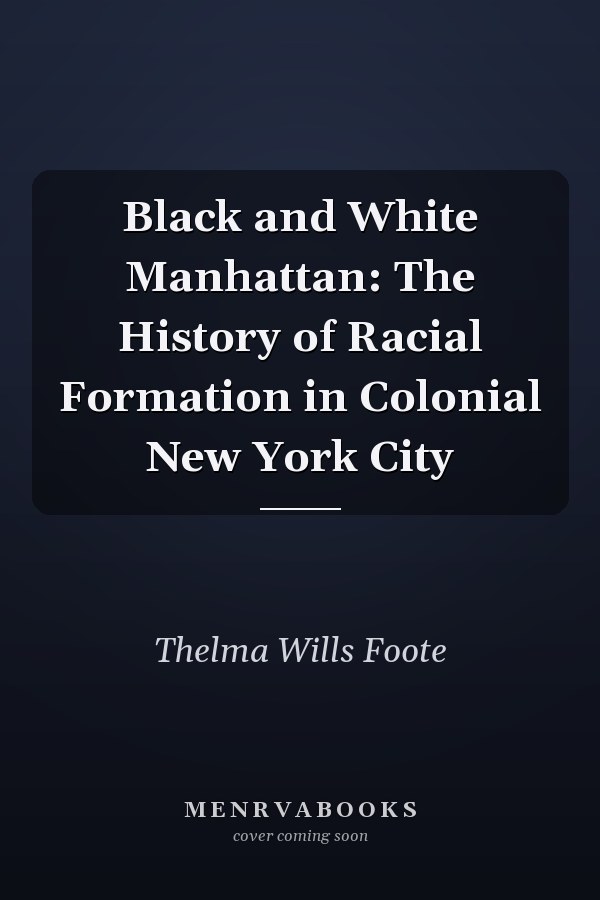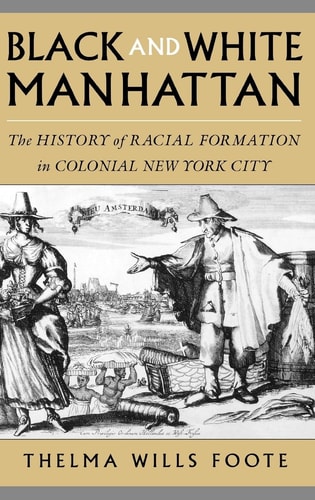
Black and White Manhattan: The History of Racial Formation in Colonial New York City
0
0
As an Amazon Associate and affiliate partner, Menrva Books earns from qualifying purchases. Learn more
Author Description
Race first emerged as an important ingredient of New York City's melting pot when it was known as New Amsterdam and was a fledgling colonial outpost on the North American frontier. Thelma Wills Foote details the arrival of the first immigrants, including African slaves, and traces encounters between the town's inhabitants of African, European, and Native American descent, showing how racial domination became key to the building of the settler colony at the tip of Manhattan Island. During the colonial era, the art of governing the city's diverse and factious population, Foote reveals, involved the subordination of confessional, linguistic, and social antagonisms to binary racial difference. Foote investigates everyday formations of race in slaveowning households, on the colonial city's streets, at its docks, taverns, and marketplaces, and in the adjacent farming districts. Even though the northern colonial port town afforded a space for black resistance, that setting did not, Foote argues, effectively undermine the city's institution of black slavery.This history of New York City demonstrates that the process of racial formation and the mechanisms of racial domination were central to the northern colonial experience and to the founding of the United States.
Menrva's Summary
THE THESIS
How did the colonial administration of New Amsterdam and early New York City utilize racial formation as a primary mechanism for social and political control? Thelma Wills Foote, a scholar of American history, examines the intersection of African, European, and Native American populations in the colonial port city. By analyzing archival evidence from the seventeenth and eighteenth centuries, she argues that the transition from diverse social antagonisms to a binary racial hierarchy was essential to the development of the settler colony and the subsequent founding of the United States.
THE SCOPE MAP
What You Will Find
- Analysis of racial formation within slaveowning households and public spaces like taverns and docks.
- Examination of the transition from linguistic and confessional diversity to binary racial stratification.
- Primary source research documenting the experiences of enslaved Africans in a northern colonial port.
- Investigation into the limitations of black resistance within the institutional framework of northern slavery.
THE AUTHORITY PERSPECTIVE
Historians and sociologists recognize this work as a significant contribution to the study of northern colonial slavery and the origins of American racial hierarchies. Scholars frequently cite the text for its detailed examination of how racial domination was constructed through everyday governance and social interaction.
Page Count:
344
Publication Date:
2004-10-28
Publisher:
Oxford University Press
ISBN-10:
0195088093
ISBN-13:
9780195088090
History
New York
Race Relations
Sociology
American History
Colonial History
Racism