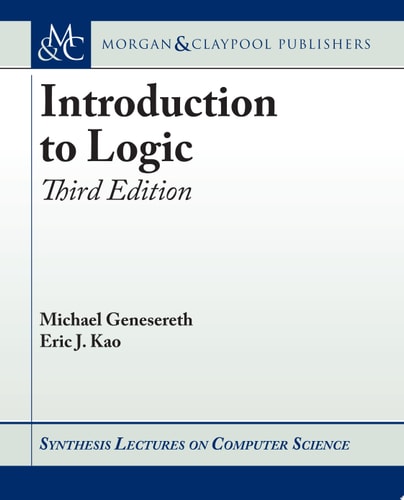
Introduction to Logic Third Edition
0
0
As an Amazon Associate and affiliate partner, Menrva Books earns from qualifying purchases. Learn more
Author Description
This book is a gentle but rigorous introduction to Formal Logic. It is intended primarily for use at the college level. However, it can also be used for advanced secondary school students, and it can be used at the start of graduate school for those who have not yet seen the material. The approach to teaching logic used here emerged from more than 20 years of teaching logic to students at Stanford University and from teaching logic to tens of thousands of others via online courses on the World Wide Web. The approach differs from that taken by other books in logic in two essential ways, one having to do with content, the other with form. Like many other books on logic, this one covers logical syntax and semantics and proof theory plus induction. However, unlike other books, this book begins with Herbrand semantics rather than the more traditional Tarskian semantics. This approach makes the material considerably easier for students to understand and leaves them with a deeper understanding of what logic is all about. In addition to this text, there are online exercises (with automated grading), online logic tools and applications, online videos of lectures, and an online forum for discussion. They are available at http://intrologic.stanford.edu/
Menrva's Summary
THE THESIS
This book offers a rigorous yet accessible introduction to formal logic, designed for college-level students and beyond. Developed from over two decades of teaching experience at Stanford University and online, the text presents a unique approach by beginning with Herbrand semantics instead of the more traditional Tarskian semantics. This pedagogical choice aims to enhance student comprehension and deepen their understanding of the fundamental nature of logic.
THE SCOPE MAP
- Coverage of logical syntax, semantics, proof theory, and induction.
- An introduction to logic beginning with Herbrand semantics.
- Explanation of Tarskian semantics as a traditional alternative.
- Online supplementary materials including exercises, tools, lectures, and a discussion forum.
- Content suitable for advanced secondary school students, college undergraduates, and early graduate students.
- A focus on making complex logical concepts understandable and memorable.
THE AUTHORITY PERSPECTIVE
The approach taken in this text, particularly its early introduction of Herbrand semantics, is designed to facilitate student understanding and retention of logical principles. The integration of online resources, including automated exercises and discussion forums, suggests a pedagogical strategy aimed at comprehensive learning and engagement. The book's design caters to a broad academic audience, from advanced high schoolers to graduate students, indicating a flexible and adaptable curriculum.
Page Count:
177
Publication Date:
2016-11-07
Publisher:
Morgan & Claypool Publishers
ISBN-10:
1627059997
ISBN-13:
9781627059992
Philosophy
Non-Fiction
Science
Computer Science
Logic
Education
Community Tags
Similar Books