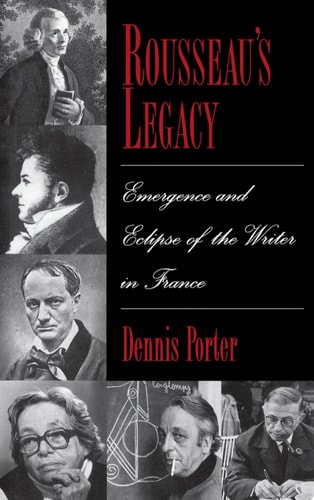
Rousseau's Legacy: Emergence and Eclipse of the Writer in France
0
0
As an Amazon Associate and affiliate partner, Menrva Books earns from qualifying purchases. Learn more
Author Description
In modern Western literary culture, the writer who combines autobiographical witness with political critique has been the object of particular veneration, as the careers of such celebrated figures as Jean-Paul Sartre and Marguerite Duras among others attest. Dennis Porter argues in Rousseau's Legacy that this cultural idea of the writer - as distinct from the more traditional "man of letters" - first emerged in France in the decades preceding the French revolution, and has continued to exercise a nominative power over intellectual life well into our own day. In Porter's paradigm, Jean-Jacques Rousseau serves as a seminal figure who combined radical critique of existing institutions with a new form of confessional writing and a suspicion of the art of literature. Rousseau inaugurated the idea of a heroic and committed writerly life in which the opposition between public and private self is collapsed. Porter combines a wide-ranging knowledge of contemporary theory and cultural history over the past two centuries in his readings of works by a number of major French writers; he situates their work in larger cultural and political transformations. In addition to the literary texts, he also touches on the "idea" of the writer as represented in paintings, engravings, and photographs. Examining the works of Stendhal, Baudelaire, Sartre, Barthes, Duras, Althusser, and Foucault, Rousseau's Legacy is of obvious interest to scholars and students of modern French literature and culture, and, given the influence of French philosophy and literary theory on literary and cultural studies in this century, it will also appeal to a broader nonspecialist readership. Porter concludes with the provocative claim that, with the collapse among intellectuals of faith in revolution, and with the degeneration of confession into the stuff of TV talk shows, the idea of the writer as an agent for moral and political change is also in eclipse.
Menrva's Summary
THE THESIS
This work investigates the historical emergence and subsequent decline of the 'committed writer' archetype in France, a figure defined by the fusion of autobiographical confession and radical political critique. Dennis Porter, an expert in literary and cultural studies, utilizes a framework centered on Jean-Jacques Rousseau to trace how this specific intellectual persona evolved from the pre-revolutionary era to the contemporary period. By analyzing the intersection of private identity and public advocacy, Porter argues that the cultural authority of the writer has been fundamentally altered by the erosion of revolutionary faith and the commodification of personal narrative.
THE SCOPE MAP
What You Will Find
- A historical analysis of the 'writer' archetype from the pre-revolutionary period to the late 20th century.
- Comparative literary readings of major French figures including Stendhal, Baudelaire, Sartre, Barthes, Duras, Althusser, and Foucault.
- An interdisciplinary examination of the writer's image as depicted in visual media such as paintings, engravings, and photographs.
- A critical assessment of how modern media and political shifts have contributed to the eclipse of the writer as a moral agent.
THE AUTHORITY PERSPECTIVE
Scholars and students of French literature frequently cite this text for its rigorous synthesis of cultural history and literary theory. The prose is noted for its academic depth, providing a foundational framework for understanding the evolution of the intellectual persona in modern Western culture.
Page Count:
320
Publication Date:
1995-05-25
Publisher:
Oxford University Press
ISBN-10:
0195091078
ISBN-13:
9780195091076
Philosophy
Biography
Authorship
Cultural History
French literature
Literary Criticism
Intellectual History
Community Tags
Similar Books